




Cloud microphysics · Ice nucleation · Aerosol–cloud interactions
I am a PhD researcher in Atmospheric Sciences at Stony Brook University. I study how aerosol particles initiate ice formation in Arctic mixed-phase clouds, combining process-based modeling, observational constraints, and single-particle aerosol analysis.
My work focuses on ice-nucleation parameterizations, aerosol and ice budgets, and the interpretation of model–observation differences during marine cold-air outbreaks.
How do freezing parameterizations and entrainment shape cloud ice?
Our AC-1D simulations examine how aerosol types and freezing parameterizations influence ice crystal budgets in mixed-phase clouds. The graphic below illustrates the contrasting evolution of ice crystal concentrations for CNT-based and singular schemes under weak and strong entrainment.
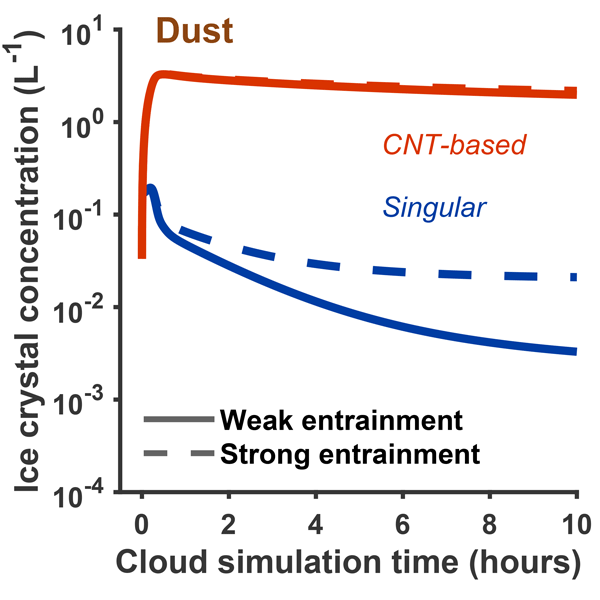
Article graphic from Sun, Fridlind, Silber, Riemer & Knopf (2026), Geoscientific Model Development, 19, 1581–1617. CC BY 4.0.
Read the paper · Model code and sensitivity tests · Analysis scripts · Simulation data
I contribute to the development and application of AC-1D, a Python model for investigating aerosol and ice-nucleating-particle evolution under cloud conditions informed by large-eddy simulations. My research uses the model to examine ice formation and aerosol–ice budgets in Arctic mixed-phase clouds.
Explore the collaborative codebase
With Daniel A. Knopf, I contributed the aerosol–INP closure tutorial to the COMBLE Model–Observation Intercomparison Project Cookbook. The notebook uses measured aerosol size distributions to compare predictions from different immersion-freezing parameterizations with observed INP concentrations at COMBLE and Zeppelin.

COMBLE closure example from the aerosol–INP tutorial by Yijia Sun and Daniel A. Knopf. Colors indicate temperature; the black line marks 1:1 agreement.
Read the tutorial · COMBLE-MIP repository
- Scientific Python: NumPy, xarray, SciPy, pandas, and Matplotlib.
- Cloud modeling and analysis: AC-1D development, LES output processing, size-resolved aerosol microphysics, ice-budget diagnostics, and uncertainty analysis.
- Single-particle measurements: STXM/NEXAFS aerosol chemical analysis, with beamtime experience at the Advanced Light Source.
- Additional tools: MATLAB, Fortran, and Git.