
A customer-support agent that answers only from its knowledge base, sends sensitive tickets to a person before any model sees them, and hands off with a ready-made note whenever it is not sure. Every routing decision is measured on a golden set of tickets plus an adversarial set, in CI, without any API key.
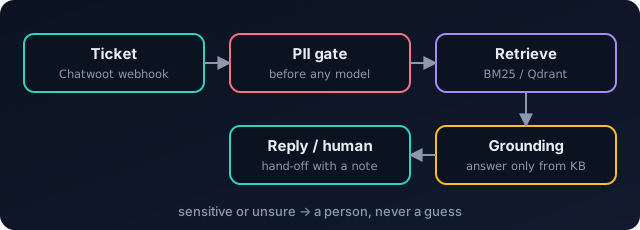
Reference implementation of the support agent I hardened for a game-server hosting company: in production it went from handling about 30% of tickets to about 70%. That system ran on n8n, Qdrant and Chatwoot and its code is private; this repo rebuilds the parts that made it safe and measurable, in plain Python, on a synthetic knowledge base and synthetic tickets. The 30% → 70% figure belongs to the client system, not to this demo.
git clone https://github.com/kotiniiqq/support-agent && cd support-agent
python -m venv .venv && . .venv/bin/activate      # Windows: .venv\Scripts\activate
pip install -e ".[dev]"                           # the Qdrant backend is the optional extra [qdrant]

support-agent ask "server crashes right after start, console shows a java error"
[answer, extractive, score 0.42]
A server that stops right after starting usually has a broken mod, a wrong Java version or a corrupted config. The console log names the cause.
1. Open the Console tab and read the last error lines before the crash.
2. If a mod is named, remove it from /mods via SFTP and start again.
3. If the log mentions Java, choose the Java version that matches your game version in Settings.
Source: Server does not start or crashes [server-wont-start]
support-agent ask "Use my card 4111.1111.1111.1111 for the renewal"[handoff: personal_data]
Handoff: the message contains personal or payment data.
Customer: customer (standard).
Message: Use my card [card ****1111] for the renewal
Trigger: [card ****1111]
ticket ─► pre-gate (rules) ──sensitive──► person: personal data · billing · abuse/legal · asks for a person · VIP
              │ clear
              ▼
          retrieve top 3 ──best score < threshold──► person: no_match
              │
              ▼
          compose answer ──model says ESCALATE / cites nothing / cites an article it was not given──► person
              │                                    any exception anywhere ──► person: error
              ▼
          reply with the source article
- Pre-gate (
pregate.py,pii.py). Deterministic rules in a fixed order, run before the index is even built.- Personal data: card numbers with any separator, confirmed by Luhn (so a 16-digit order number is not a card); IBANs in any case, confirmed by mod-97; phone numbers; passports; password-like tokens next to "password/пароль".
- Billing, legal and requests for a person: word stems rather than exact words ("suing", "lawyers", Ukrainian and Russian case forms).
- Request context: asking for a person needs one ("talk to an agent", "з'єднайте з оператором"), so "file manager" or "how do I make myself operator" stay how-to questions.
- Sensitive tickets never reach retrieval or a model.
- Retrieval (
retrieval.py). BM25 in pure Python by default, or Qdrant with a pluggable embedder. BM25 scores are normalised against the best score the query could reach. Pleasantries ("hi team, hope you're doing great…") are dropped, so a chatty ticket is not drowned by its own greeting. - Answer (
answer.py). Without a key, the matching article's summary and steps, with the source. WithOPENROUTER_API_KEY, a model rephrases only the passages that passed the threshold and must cite them as[article-id]. No citation, an unknown citation, a reply that is only a citation, orESCALATEanywhere becomes a handoff. - Handoff note (
summary.py). Reason, trigger, customer, the message with personal data masked, and the closest articles, so the person starts with context. - The agent never raises (
agent.py). A failing index, a broken model or a malformed ticket becomes a handoff. A billing ticket still reaches a person when the index is down.
support-agent evalGolden set. 50 tickets in src/support_agent/eval_cases/tickets.yaml:
- 28 answerable, including 4 long, chatty ones;
- 15 sensitive;
- 7 outside the knowledge base.
Latest run (evals/RESULTS.md):
| retriever | threshold | routing accuracy | sensitive to a person | answered correctly, of answerable | wrong answers | false handoffs | hit@1 |
|---|---|---|---|---|---|---|---|
| bm25 (default) | 0.15 | 0.88 | 1.0 | 0.786 | 0 | 6 | 0.857 |
| qdrant + hash embedder | 0.25 | 0.70 | 1.0 | 0.464 | 0 | 15 | 0.893 |
Adversarial set. 62 sensitive and 23 ordinary phrasings, written by an independent reviewer to break the pre-gate:
- "I am suing you", "соедините с оператором", "card 4111.1111.1111.1111", "how do I make myself operator", "my sftp password is not working"…
- The first version of the rules missed about 45 of them. That is how the stem-based rules above came about.
- Result now: 62/62 reach a person with the right reason. One ordinary question is blocked: "how do I change the game version, my plan is paid" goes to billing, which errs on the safe side.
- The rules were fixed against this set, so it is now a regression set, not a held-out one.
The threshold is a product decision, and the sweep makes it visible. For BM25:
| threshold | answered correctly, of answerable | wrong answers | false handoffs |
|---|---|---|---|
| 0.05 | 0.857 | 6 | 2 |
| 0.10 | 0.857 | 2 | 3 |
| 0.15 | 0.786 | 0 | 6 |
| 0.25 | 0.714 | 0 | 8 |
The default is the lowest threshold with no wrong answer, because a wrong answer to a customer costs more than an extra ticket for a person. Each retriever gets its own threshold: cosine similarities and normalised BM25 scores are not on the same scale.
What the numbers also show, honestly:
- Keyword retrieval stops at paraphrase. "The whole world got wiped, can we roll it back?" never says backup or restore, so BM25 hands it off. The same goes for a Ukrainian question against an English knowledge base. That is a safe failure (a person gets it), and the fix is a real multilingual embedding model behind the Qdrant backend, not a longer keyword list.
- The hash embedder is not a semantic model. It exists so the Qdrant path runs offline and in
CI. Plug a real one in with
SA_EMBED_KEY(any OpenAI-compatible/embeddingsendpoint), then run the sweep again to pick its threshold before using it. - The threshold was chosen on the same golden set it is reported on. There is no held-out split yet. Treat 0.786 as an optimistic number.
- The evals cover the routing layer (who answers and from which article), which runs without a key. The wording of model-written answers needs an LLM judge and a key. The grounding check is unit-tested with a fake model.
CI fails if:
- any sensitive ticket, golden or adversarial, is answered automatically;
- any BM25 answer cites the wrong article;
- more than one ordinary adversarial question is blocked;
- routing accuracy drops below 0.85.
export CHATWOOT_URL=https://app.chatwoot.com CHATWOOT_ACCOUNT_ID=1 CHATWOOT_API_TOKEN=...
export CHATWOOT_WEBHOOK_TOKEN=some-long-random-string     # required whenever CHATWOOT_* is set
support-agent serve --host 0.0.0.0 --port 8000
# webhook: POST https://your-host/webhook/chatwoot with header X-Webhook-Token (or ?token=)
On a new customer message the agent either posts the reply, or leaves a private note with the
handoff summary and moves the conversation to the agents' queue (pending → open).
The bot only speaks in conversations it owns: status pending and no assignee. Once it hands off,
or a person takes over, it stays silent. Outgoing messages, private notes and redelivered events
are ignored.
The handler runs in a worker thread, so the synchronous agent does not block the server. Without
CHATWOOT_* it runs in dry-run mode and returns the action it would take. The client is tested
against fixtures modelled on the Chatwoot API docs, not against a live instance.
Every decision appends a line to .traces/YYYY-MM-DD.jsonl, with personal data masked:
- route, reason, score and sources;
- retriever, threshold and latency;
- for LLM calls, also tokens and cost.
support-agent stats turns the traces into coverage and handoff reasons, the number a support
lead asks for. Eval runs do not write traces, so they never inflate that number.
src/support_agent/
  pregate.py  pii.py  redact.py           rules that decide before any model; one set of PII detectors
  kb.py  retrieval.py                     knowledge base, BM25 and Qdrant
  answer.py  llm.py  summary.py           answer composition, grounding check, handoff note
  agent.py                                the pipeline; never raises
  webhook.py  chatwoot.py  cli.py         interfaces
  evals.py  tracing.py                    measurement
  kb/  eval_cases/                        synthetic articles, golden and adversarial tickets (ship with the package)
scripts/write_kb.py                       regenerates the knowledge base
tests/                                    130 tests, no network
- A written design spec and implementation plan.
- Test-first implementation, task by task, with every diff reviewed.
- A review of the whole repository whose job was to break it.
That review is the most useful part of the history:
- The safety claim was hollow. The golden sensitive tickets reused the rules' own keywords, so "sensitive recall 1.0" proved nothing. The reviewer's paraphrases slipped through, and its phrasings are now the adversarial set.
- The bot would have talked over human agents. Once a conversation was handed off, it kept replying.
- A billing ticket got a 500 instead of a handoff when Qdrant was down.
- A greeting hid the question. "Hi team, hope you're well…" pushed a simple question below the threshold.
All of these are fixed, and each fix is pinned by a test.
Feedback, ideas, job offers or custom projects (n8n, MCP, AI automation): kotiniiqq@gmail.com. Bug reports and feature requests are welcome in Issues.
MIT