


Problem · Results · Mine it · How it works · Docs
BitTrellis automatically searches for the best way to compress an LLM for a particular GPU, while keeping as much of the original model's quality as possible.
Qwen3.8-27B needs about 52 GB as released. An RTX 5090 has 32 GB. So the model must be compressed (quantized) into formats like NVFP4, FP8 or Q4_K. It then fits, but it no longer answers exactly like the original.
The usual approach uses one recipe everywhere:
layer 1 → NVFP4 layer 2 → NVFP4 … layer 64 → NVFP4
But layers are not equal. Some shrug off compression, some lose quality, and some improve just by using a better compression algorithm in the same format. So the real question is:
What is the best compression recipe for this exact model on this exact GPU?
It tries recipes, builds each one into a real checkpoint, and measures it on the real GPU. Each column below is one layer; the color is how that part is compressed.

Every candidate answers four questions, and only the best trade-offs survive:
| Question | Why it matters | |
|---|---|---|
| 1 | How close is it to the original model? | the quality you keep |
| 2 | How fast does it generate text? | chat and agent speed |
| 3 | How fast does it read a long prompt? | time to first token |
| 4 | How much GPU memory does it need? | what fits, how much context |
A win looks like this: same speed, same memory, but the model behaves more like the original. Using less memory at the same quality, or a better overall balance, counts too. BitTrellis is not mainly a speed project — it is about keeping quality while fitting the hardware.
| SparkInfer | BitTrellis | |
|---|---|---|
| Asks | How can we run this model faster? | Which compressed version should run? |
| Works on | CUDA kernels, prefill, decode, KV cache | formats, encoders, which parts get which |
| In short | a better engine | a better model for that engine |
The private holdout changed the answer. The recipe that looked best on the public corpus does not hold up on text nobody has seen, so it earns nothing. What survives is memory savings. Full numbers: feasibility report.

- A public gain is not a real gain. V13 (a calibrated MLP encoder) is 11.5% closer to the original on the public corpus, but only 2.9% closer on the private holdout: 9% of the gain carries over, against the 50% the rule requires. It fails. V3 (8-bit recurrent layers) carries 44% over and also fails.
- What does survive: memory. Q4_K maps keep quality within noise and save real memory — V1 −1.8 GiB, V6 −1.2 GiB — and they pass the holdout. The price is prompt reading, up to −49%.
- Fidelity is not task accuracy. On all 784 task questions the spread is small: V1 575, V0 570, V13 566. Drift measures how closely a model copies the original, not whether it is smarter.
- Plenty of headroom. Outside references are 35–53% closer to the original on the public corpus, at a large speed cost. Whether that carries over to unseen text is untested.
The frontier is the set of checkpoints nothing else beats on every measure at once, after every gate. New results earn only by pushing it forward.
| Checkpoint | Drift ↓ | Tasks ↑ | Generation tok/s ↑ | 4K prompt tok/s ↑ | Peak GPU GiB ↓ | Holdout | |
|---|---|---|---|---|---|---|---|
| ★ | V1 everything Q4_K | 0.124 | 575/784 | 94.8 | 7,537 | 20.3 | PASS |
| ★ | V6 MLP Q4_K | 0.135 | 563/784 | 94.4 | 8,358 | 20.8 | PASS |
| ★ | V0 today's shipped checkpoint | 0.136 | 570/784 | 94.9 | 14,760 | 22.0 | incumbent |
| ★ | V4 recurrent path Q4_K | 0.142 | 566/784 | 94.9 | 12,011 | 21.6 | PASS |
| ✗ | V3 recurrent path FP8 | 0.113 | 573/784 | 83.0 | 11,848 | 23.9 | FAIL (44% transfers) |
| ✗ | V13 calibrated MLP encoder | 0.120 | 566/784 | 94.4 | 14,110 | 22.0 | FAIL (9% transfers) |
| ✗ | V5 attention Q4_K | 0.136 | 556/784 | 94.6 | 13,571 | 21.9 | task guard: −33 answers |
Drift is Reference-Partition KL against the BF16 original: how far next-token predictions move, not task accuracy. ✗ rows are measured but cannot be credited. V7 and V9 are valid but beaten by a frontier point.
Comparison targets. Just as llama.cpp is SparkInfer's yardstick, BitTrellis measures outside checkpoints on the same GPU, corpus and metric. They show what is possible but are never ranked:
| Reference | Drift ↓ | Generation tok/s ↑ | 4K prompt tok/s ↑ | Peak GPU GiB ↓ | |
|---|---|---|---|---|---|
| R2 | llama.cpp + unsloth UD-Q4_K_M GGUF | 0.064 | 79.9 | 3,616 | 16.2 |
| R1 | unsloth NVFP4 checkpoint on SparkInfer | 0.088 | 82.4 | 10,305 | 23.6 |
| R3 | NVIDIA NVFP4 checkpoint | — | — | — | — |
llama.cpp is a different engine. The unsloth checkpoint is not a legal manifest (its FP8 attention bytes are silently refit to Q4_K at load). R3 cannot load at all: its FP8 scales are per tensor, and the pinned loader accepts only per-row scales.
The miner's target: a fidelity gain that survives the private holdout. Nothing has managed one yet.
You don't rewrite the inference engine. You submit a better model for it — and get paid on Gittensor when it merges.
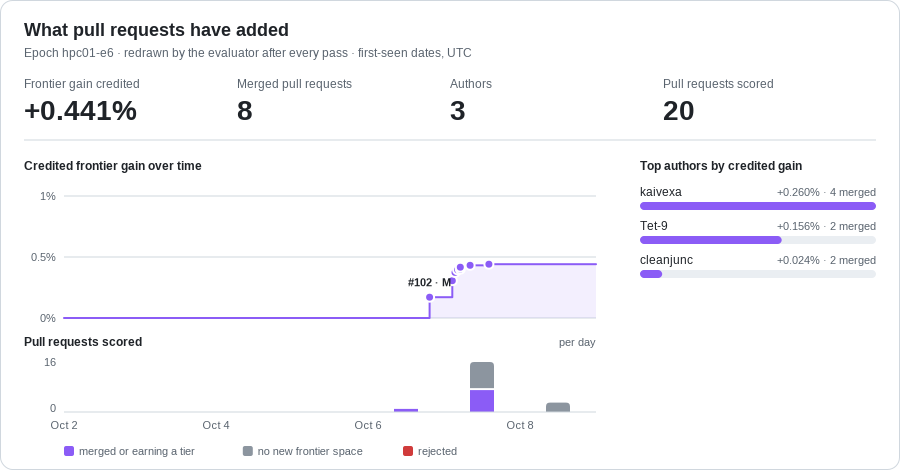
Redrawn by the evaluator after every pass from the public score records. Want a checkpoint rather than to mine? Which checkpoint to use →

- Read what the seeds measured in the feasibility report.
- Write a recipe,
manifests/<name>.yaml, or a new quantizer plus the recipe that uses it. - Open a PR. The evaluator bot screens it, measures it, and comments with the score.
- Get a tier — the only thing Gittensor pays, when the evaluator merges the PR:
| Tier | Frontier space added beyond noise (FG-2) | Multiplier |
|---|---|---|
 |
≥ 0.50% | ×4.0 |
 |
≥ 0.25% | ×2.5 |
 |
≥ 0.12% | ×1.5 |
 |
≥ 0.035% | ×1.0 |
 |
≥ 0.005% | ×0.5 |
  |
nothing new, or failed | ×0 |
For scale: on today's frontier V0 scores eval:XL, V4 and V1 eval:S, V6 eval:XS. A tier also needs a private holdout PASS: V13 and V3 have none, so they earn nothing. Duplicates earn nothing, and a near-copy of
an earlier PR earns only what it adds.
Start here: Miner guide · Rewards · Guards
git clone https://github.com/coderbench/bittrellis && cd bittrellis
pip install -e ".[dev]"
pytest -q                                   # build · audit · tamper detection · RP-KL · frontier · bot

bittrellis quantizers                       # runtime · baseline · unsloth · rtn
bittrellis inventory                        # 273 units · 144 GDN · 64 attention · 64 MLP · lm_head
bittrellis manifest experiments/feasibility/variants/V13-mlp-unsloth-bytes.yaml --expand
A recipe is a few lines of YAML:
schema: bittrellis/manifest@2
track: HPC-01
name: calibrated-mlp-gdn-fp8-deep-qkv
default: NVFP4
rules:
  - match: "L*.mlp"
    layers: "0-55"
    format: NVFP4
    quantizer: unsloth          # calibrated bytes, attested
  - match: "L*.gdn.qkv"
    layers: "48-63"
    format: FP8                 # protect the deep state-writing projections
Measure it yourself on an RTX 5090
scripts/setup_sparkinfer.sh                 # pinned runtime + the quality-measuring tool
scripts/setup_models.sh                     # base · shipped · unsloth, hash-verified
bittrellis doctor
bittrellis reference                        # BF16 reference distributions, once

bittrellis build manifests/mine.yaml --out models/candidates/mine
bittrellis evaluate models/candidates/mine --out artifacts/mine
bittrellis compare results/feasibility/artifacts/V0-baseline-rebuild artifacts/mine
bittrellis frontier --with-seeds artifacts/mine
| Model | Qwen3.8-27B: 64 layers, 48 Gated DeltaNet + 16 full attention; BF16 weights hash-locked |
| GPU | 1× NVIDIA GeForce RTX 5090 (32 GB) |
| Runtime | SparkInfer v0.5.8 @ b1ed168, kernels unmodified, every runtime knob pinned |
| Search space | 273 units × legal execution format × legal quantizer |
| Fidelity | Reference-Partition KL vs BF16 on a 78K-token corpus (21,624 scored positions) |
| Objectives | RP-KL ↓ · decode tok/s ↑ · 4K prefill tok/s ↑ · peak GPU memory ↓ |
| Guards | screen · audit · runtime correctness · 8K/16K/32K needles · task guard · private holdout |
| Frozen | architecture, tokenizer, every non-searchable tensor, the BF16 source weights |
Everything is pinned in configs/hpc01.yaml and
configs/sources.lock.json. The rules are in the
specification.
| Term | Meaning |
|---|---|
| Unit | The smallest piece whose format the runtime lets you choose: L7.attn.q, L40.gdn.z, L12.mlp, lm_head. There are 273. |
| Manifest | A few lines of YAML assigning format @ quantizer to every unit. It is the submission. |
| Quantizer | What produces a unit's bytes: runtime (Q4_K), rtn (regenerable), baseline / unsloth (attested), or yours. |
| Audit | Proof that a checkpoint is nothing but legal encodings of the hash-locked weights. |
| RP-KL | How far next-token predictions drift from BF16, on BF16's top-256 tokens plus a tail bucket. Never larger than full KL; compared position by position. |
| FG-2 | Frontier Gain: the share of the normalized quality × speed × memory space a result adds. It decides the tier. |
What runs is what counts — the loader decides the executed format
A checkpoint can store anything; the pinned loader decides what executes:
                        stored ▸   NVFP4          FP8 (per row)      BF16
   ─────────────────────────────────────────────────────────────────────────
   GDN  qkv · z · out   runs  ▸   NVFP4          FP8                Q4_K fit
   attention q·k·v·o    runs  ▸   NVFP4          Q4_K refit (!)     Q4_K fit
   MLP  gate·up·down    runs  ▸   NVFP4          Q4_K refit (!)     Q4_K fit
   lm_head   batch 1    runs  ▸   Q4_K refit     Q4_K refit         Q4_K fit
             packed     runs  ▸   NVFP4*         Q4_K refit         Q4_K fit      * if VRAM allows
A manifest names what runs; anything the runtime would silently convert is rejected. Q4_K is a runtime fit with no encoder choice. FP8 executes only on GDN. Evidence, down to the loader functions: docs/precision_space.md.
Repository layout
bittrellis/
├── configs/                 hpc01.yaml (every pin, gates, tiers) · sources.lock.json (every source hash)
├── bittrellis/
│   ├── model/qwen38.py      config + loader contract → 273 units
│   ├── precision.py         legal formats, loader resolver, executed-format semantics
│   ├── manifest.py          rules → FORMAT@quantizer@vN per unit → candidate id
│   ├── quantizers/          plugin contract · runtime · attested · regenerable (+ yours)
│   ├── build.py             deterministic checkpoint writer (CPU)
│   ├── validate.py          audit: frozen bytes, execution map, lineage replay
│   ├── fingerprint.py       encoder fingerprints for the copy guard
│   ├── eval/                corpus · BF16 reference · RP-KL · tasks · 2-run perf · llama.cpp
│   ├── holdout.py           private rotating holdout, PASS/FAIL
│   ├── frontier/            gates · ε-dominance · FG-2 · reports
│   └── search.py            baseline one-group neighbors
├── tools/                   programs that measure how close a checkpoint stays to the original
├── evaluator/               PR bot · guards · sandbox (for validators)
├── data/corpus/             public fidelity corpus (hash-verified)
├── experiments/feasibility/ seed manifests, runner, analysis
├── results/feasibility/     seed artifacts = initial frontier, report, plots
└── docs/                    specification · guides
What this is not: another inference runtime, a generic quantization library, or a wrapper around
quantize(model, bits=4). Quantization libraries provide primitives, SparkInfer provides execution,
and BitTrellis searches the deployable artifact between them — one model × runtime × GPU at a
time (today: Qwen3.8-27B × SparkInfer × RTX 5090; each next model or GPU is its own track).
| If you want to… | Read |
|---|---|
| start mining | Miner guide · Manifests · Search |
| write an encoder | Quantizer contract · Precision space |
| know how you are scored | Evaluation · Frontier · Rewards |
| know what is rejected | Guards · Audit · Holdout · Security |
| check the published scores | Score records · Rewards |
| run the evaluator on a GPU | Evaluator runbook · Holdout |
| read the rules and evidence | Specification · Architecture · Feasibility report |
MIT license · Contributing