
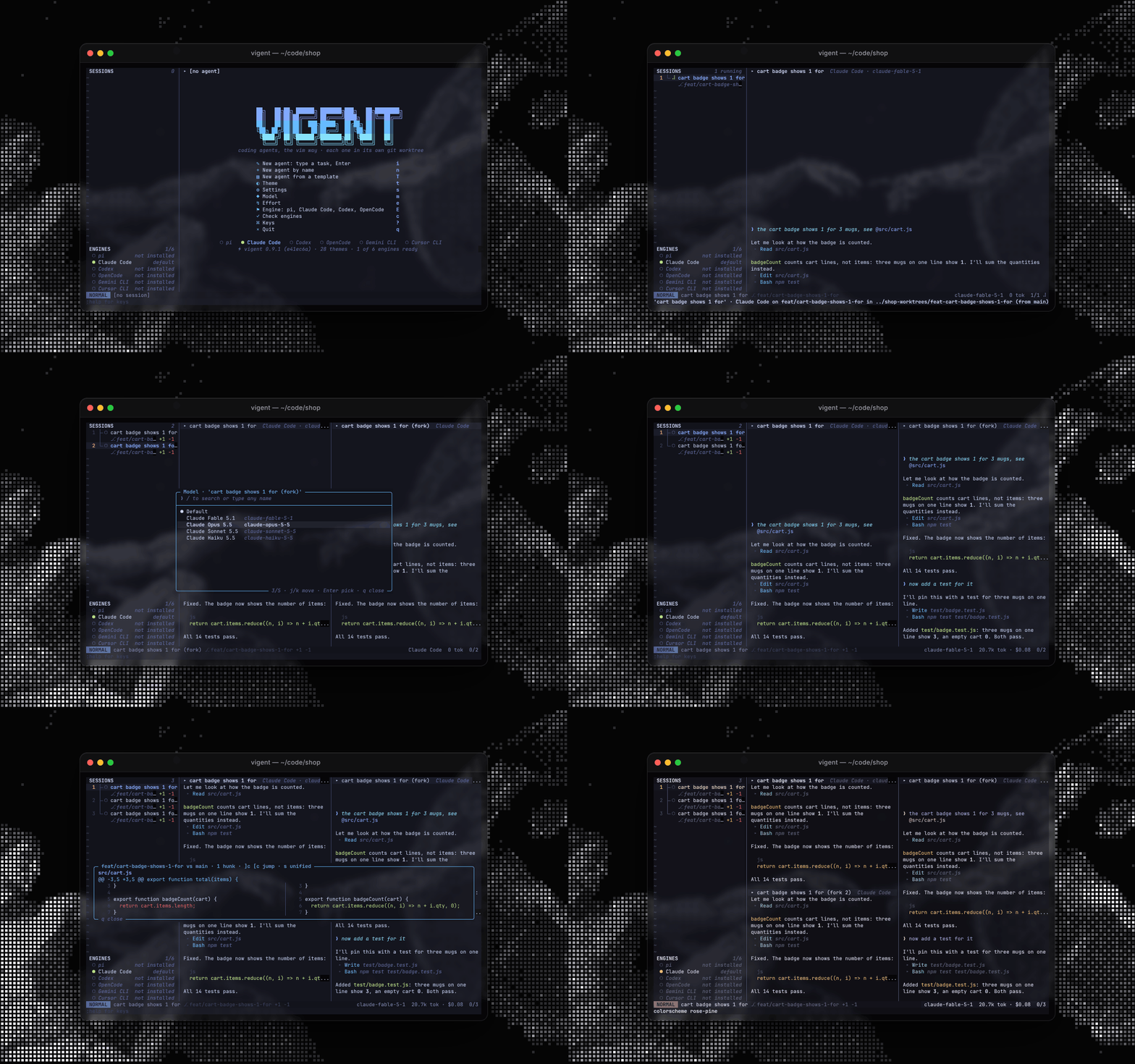
A vim-native orchestrator for coding-agent harnesses. Claude Code, Codex, OpenCode, Gemini CLI, Cursor CLI and pi are harnesses: each runs its own agent loop (the model calls, the tools, the permissions) with its own login. vigent runs the ones you already have side by side, each in its own git worktree, and gives you one vim-native screen to watch them, steer them and land their work. It bundles none of them and never reads their credentials.
Website: vigent.farming-labs.dev · Docs: vigent.farming-labs.dev/docs
npm install -g @vigent/cliAbout 5 MB, most of it riftri's binary for lightweight worktrees. Needs Node.js 20+ and git. The command is vigent.
Or the standalone binary: one file of about 3 MB that needs git and no Node, with every engine and riftri inside (docs/binaries.md):
curl -fsSL https://vigent.farming-labs.dev/install.sh | sh     # macOS, Linux
brew install farming-labs/tap/vigent                           # or Homebrew
irm https://vigent.farming-labs.dev/install.ps1 | iex # Windowsvigent # in a git repo: new agents use the first agent CLI you're signed in to
vigent --engine codex # or pick one: claude, codex, opencode, gemini, cursor, pi
vigent --demo # scripted agents, nothing installed neededPress i, type what you want done, and press Enter. An agent starts on it in its own worktree and branch. i again sends a follow-up, Esc goes back to NORMAL mode, and :new <task> starts another agent. Press Space and pause to see every key.
- Many agents, one screen. A sidebar of agents, switch with
<Space>1–9or]s/[s. Each one gets a bell or desktop notification when it finishes or needs you. - Race your harnesses.
:race <task>gives the same task to every harness you're signed in to, a worktree each, or to the models you name with--models claude-opus-5-5,gpt-5.5. Compare how long each took and what it changed, then:race pickkeeps one and removes the rest. - A worktree per agent. Agents never touch your checkout or each other's files. With riftri, worktrees share copy-on-write storage, so ten agents cost about one checkout of disk.
- Review and land.
:diff(or side by side),:reviewto drop hunks you don't want, then:mergeor:pr. - Harnesses as installed, orchestrated. vigent doesn't call models or run tools itself: it starts each harness in its worktree, reads the events it streams (replies, tool calls, usage), and handles everything around the loop: queues, permissions, approvals, restarts, hooks, review and merge.
:checkhealthshows which harnesses are installed and signed in. - Vim all the way. Modes,
/search, folds, visual mode,:set,:nmap,:command, a which-key panel, and your Neovim colorscheme. - Themes that change the layout.
nebulalooks like a dressed-up Neovim (a lualine-style statusline, Nerd Font icons);neonputs each agent in a card and your prompts in chat bubbles;zenkeeps it quiet: one row per agent, Nerd Font icons when you have the font.[style]mixes any layout and icons with any colors. - Follow from your phone.
:serveshows an address and an access code.
vigent calls the harness an agent runs on its engine.
| Engine | vigent runs |
|---|---|
| Claude Code | claude -p --output-format stream-json |
| Codex | codex exec --json |
| OpenCode | opencode run --format json |
| Gemini CLI | gemini --output-format stream-json |
| Cursor CLI | cursor-agent --print --output-format stream-json |
| pi | pi --mode rpc, one per agent |
Any other agent CLI that takes a prompt is a few lines of config (recipes for Amp, Copilot CLI, Aider, Goose and Qwen Code are in docs/config.md):
[engines.aider]
command = ["aider", "--yes-always", "--message", "{prompt}"]:new fix flaky checkout test " a new agent on branch fix/flaky-checkout-test
:race fix flaky checkout test " the same task on every signed-in engine; :race compares, :race pick keeps one
:diff " what the focused agent changed
:review " go through its changes hunk by hunk, drop what you don't want
:merge " squash-merge its branch into yours
:pr " push the branch and open a pull request
:dash " every agent at a glance
:model / :effort " pick a model or reasoning effort
:permissions " what each agent may do without asking (gh, git, web, sandbox, network)
:kill " stop the agent, keep its work (:kill! also removes the worktree)Agents survive a restart: start vigent again in the same repo and they come back with their conversations.
vigent config init writes a commented ~/.config/vigent/config.toml, and vigent config check validates it. A repository can add its own .vigent.toml for the team's theme, templates, keys and hooks. The hooks and anything else that runs commands only run after you :trust the file.
theme = "tokyonight"            # or "nvim": follow your Neovim colorscheme
engine = "claude"

[keys.normal]
"<leader>t" = "theme.picker"

[hooks]
worktree_created = "npm ci"     # set each new worktree up before the agent starts
before_merge = "npm test"       # :merge and :pr only land a passing branch

[commands]
Test = "!npm test"              # :Test runs in the agent's worktree
Themes, templates, keymaps, commands, engines and setups other people made are one command away. vigent add shows the file, and every command it runs, before it asks:
vigent add --list                  # what's in the registry
vigent add harbor                  # a theme; :colorscheme harbor
vigent add pnpm-monorepo           # a .vigent.toml for this repo, waiting for :trust
vigent add land # a command: :Land runs the tests, then opens a pull request- Using vigent: engines, worktrees, reviewing, notifications,
:serve, every key - Configuration: every option, engine setting, hook, command and key
- Registry:
vigent add, what it checks before it adds anything, and how to share your own entry - Themes: 28 built-in themes, a Neovim-style setup with Nerd Font icons, layout styles (cards or compact sidebar, labeled or bubble messages, your own icons), importing any vim or Neovim colorscheme
git clone https://github.com/farming-labs/vigent && cd vigent
npm install
npm test          # build and run the test suite
npm run demo      # scripted agents
To release: bump version in package.json, merge, and push a matching tag (git tag v0.4.1 && git push origin v0.4.1), or run Tag a release from the Actions tab, which tags main and starts the release workflows. The Release workflow tests the code and publishes it with npm trusted publishing: no npm token, and every version gets provenance. The standalone binary (no Node needed) is the Rust port in crates/vigent, about 3 MB (a 1.3 MB download) with riftri inside, and the same tag publishes it; docs/binaries.md has how it's built, checked and published.