


THD, SNR, SINAD and THD+N of a signal in one call, from its FFT spectrum.
pip install harm-analysisThe harmonic analysis package uses FFT to estimate parameters of an input signal. The package provides two main functions:
harm_analysis: for simulations with an injected tone, returning SNR, THDN, Noise, etc.spec_analysis: for cases without an injected tone, that auto-detects DC, tones, and noise from the spectrum.
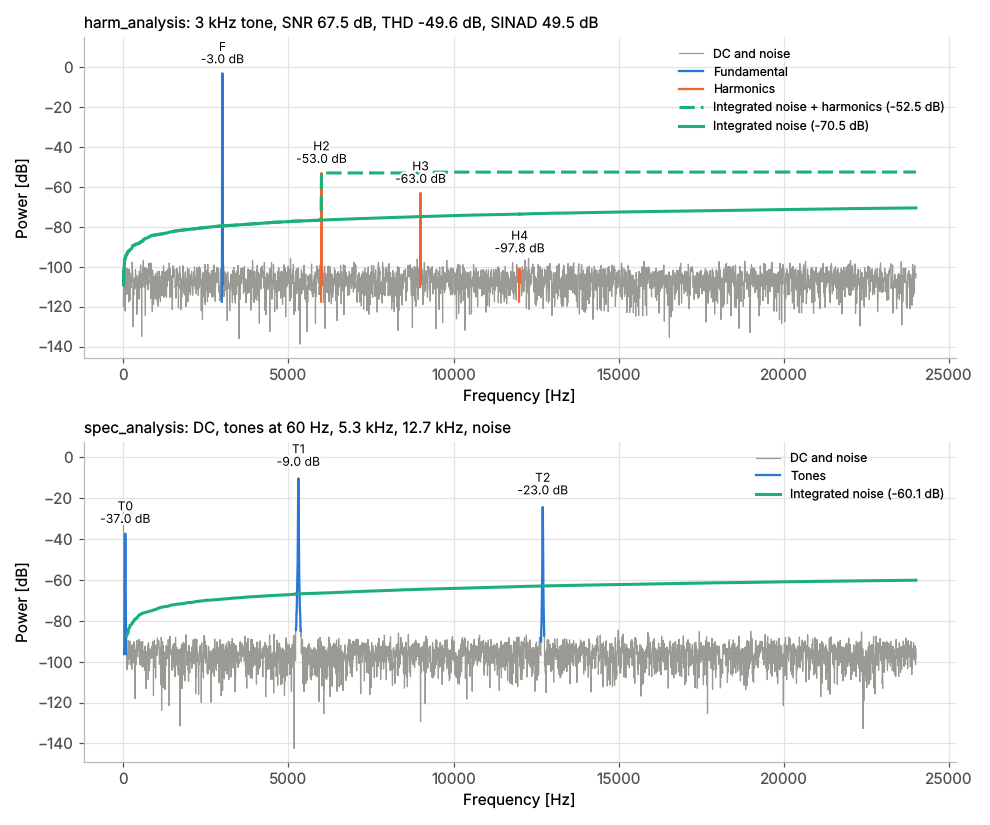
- One call, all the metrics: fundamental, harmonics, DC, noise, THD, SNR, SINAD and THD+N.
- Works on real data: no coherent sampling needed; windowing and spectral leakage are handled for you.
- No known tone?
spec_analysisfinds DC, tones and the noise floor by itself. - Plots included: pass
plot=Trueto draw the annotated spectrum. - Command line too:
harm-analysisandspec-analysisanalyze a text file directly.
A 1 kHz tone with a -60 dB second harmonic and some noise:
import numpy as np
from harm_analysis import harm_analysis

rng = np.random.default_rng(0)
fs = 48000
t = np.arange(4096) / fs
x = np.sin(2 * np.pi * 1000 * t) + 1e-3 * np.sin(2 * np.pi * 2000 * t) + 1e-4 * rng.standard_normal(t.size)

r = harm_analysis(x, fs=fs)
for name, value in r.to_dict().items():
    print(f"{name:>15}: {np.round(value, 2)}")
Output:
        fund_db: -3.01
      fund_freq: 1000.0
      harm_freq: [1999.97 3022.05 4023.99 4958.22 5971.06]
        harm_db: [ -63.   -107.8  -103.57 -105.74 -103.45]
          dc_db: -109.41
       noise_db: -79.32
         thd_db: -59.99
         snr_db: 76.31
       sinad_db: 59.89
        thdn_db: -59.89
 total_noise_db: -79.32
Powers are in dB (a unit-amplitude sine is -3 dB); thd_db, snr_db, sinad_db
and thdn_db are relative to the fundamental.
See usage for examples.
AI assistants (Claude, GitHub Copilot, ...) can run the analyses through the included MCP server; see AI assistants.
pip install harm-analysis