

An open file format for parametric simulation studies,
with libraries for Python, MATLAB, Julia, C++ and C.

Gamut is a file format for parametric simulation studies: the hundreds or thousands of CFD or FEA runs behind a design sweep, an aerodynamic database or a surrogate model. One file holds the run table, each run's inputs, results and status, and, when the runs have a mesh, the mesh and every field on it, all with units. Python, MATLAB, Julia and C++ read and write it with the same calls. Files are HDF5 laid out as netCDF-4, so h5py, xarray and the netCDF tools open them too, and a published specification says what every array in them means.

Nine runs of potential flow past a cylinder on one mesh: eight written as
a sweep, a ninth added after reopening the file, then the pressure at one
node read back from every run. points, cells and solve stand for
your mesh and your solver, and the complete programs are in
examples/.
Python
with gamut.create("cylinder.gamut", writer="example sweep", mesh="shared", per="fixed",
                   coordinates={"units": "m", "axes": 2},
                   parameters={"gamma": {"units": "m2 s-1", "role": "design"}},
                   fields={"cp": {"units": "1", "at": "node"}}) as study:
    study.set_mesh(points, cells)
    for gamma in np.linspace(0.0, 3.5, 8):
        study.add_run({"gamma": gamma}, fields={"cp": solve(gamma)})

with gamut.open("cylinder.gamut", mode="a") as study:
    study.add_run({"gamma": 4.0}, fields={"cp": solve(4.0)})

with gamut.open("cylinder.gamut") as study:
    cp = study.get_field("cp", nodes=[12])                 # runs x nodes
MATLAB
study = gamut.create('cylinder.gamut', 'writer', 'example sweep', 'mesh', 'shared', 'per', 'fixed', ...
    'coordinates', struct('units', 'm', 'axes', 2), ...
    'parameters', struct('gamma', struct('units', 'm2 s-1', 'role', 'design')), ...
    'fields', struct('cp', struct('units', '1', 'at', 'node')));
study.setMesh(points, cells);
for gamma = linspace(0, 3.5, 8)
    study.addRun(struct('gamma', gamma), 'fields', struct('cp', solve(gamma)));
end
study.close();

study = gamut.open('cylinder.gamut', 'mode', 'a');
study.addRun(struct('gamma', 4), 'fields', struct('cp', solve(4)));
study.close();

study = gamut.open('cylinder.gamut');
cp = study.getField('cp', 'nodes', 13);                         % runs x nodes, from 1
study.close();
Julia
Gamut.create("cylinder.gamut"; writer="example sweep", mesh="shared", per="fixed",
              coordinates=(units="m", axes=2),
              parameters=Dict("gamma" => (units="m2 s-1", role="design")),
              fields=Dict("cp" => (units="1", at="node"))) do study
    Gamut.set_mesh!(study; points, cells)
    for gamma in range(0, 3.5; length=8)
        Gamut.add_run!(study, Dict("gamma" => gamma); fields=Dict("cp" => solve(gamma)))
    end
end

Gamut.open("cylinder.gamut"; mode="a") do study
    Gamut.add_run!(study, Dict("gamma" => 4.0); fields=Dict("cp" => solve(4.0)))
end

cp = Gamut.open("cylinder.gamut") do study
    Gamut.get_field(study, "cp"; nodes=[13])                 # runs × nodes, from 1
end
C++
auto study = gamut::create("cylinder.gamut", "example sweep", "shared", "fixed");
study.declare_coordinates("m", 2);
study.declare_parameter("gamma", "design", "m2 s-1");
study.declare_field("cp", "node", "1");
study.set_mesh(points, cells);
for (double gamma = 0.0; gamma < 3.75; gamma += 0.5)
  study.add_run({{"gamma", gamma}}, {{"cp", solve(gamma)}});
study.close();

study = gamut::open("cylinder.gamut", "a");
study.add_run({{"gamma", 4.0}}, {{"cp", solve(4.0)}});
study.close();

study = gamut::open("cylinder.gamut");
auto cp = study.get_field("cp", gamut::all, {12});    // runs x nodes
All four print the same values:
cp at the top of the cylinder, run by run: -3.00 -2.69 -2.39 -2.10 -1.83 -1.57 -1.32 -1.08 -0.86
MATLAB and Julia count positions from 1, so node 12 in Python and C++ is node 13 in MATLAB and Julia.
| Use one file everywhere | Python, MATLAB, Julia, C++ and C call one core, so a query returns the same values in each, and each reads what another wrote. |
| Read only what you need | Choose runs by condition (mach > 0.7 and status == converged) and nodes by zone. On a shared mesh, one region of every run or one node across thousands of runs is a single read, and Python can convert values to the units you ask for (reading parts). |
| Train models on it | Each field on a shared mesh is one block of runs × nodes (or cells). Labels record status, fidelity or solver, a split says which rows are for training and which for testing, and a file can name the group a fair test must hold out whole. Standard deviations, quantiles and derivatives are stored beside the results they describe (run tables, uncertainty). |
| Share fitted models | A model is a file in the same format with no runs and no code inside. Evaluating it on new inputs gives an ordinary study; a model type of your own is registered by the software that defines it (models). |
| Hold tables, families and time series | A table of runs with no mesh, one mesh for every run, one geometry per member of a family of shapes on one topology, a mesh per run, or transient runs with a row per saved step (families, time series). |
| Check what you receive | Writers require units on parameters, results, constants and coordinates, and gamut validate checks the 35 numbered rules of the specification. A corpus of 65 valid, broken and hostile files runs in CI through the Python, MATLAB and Julia libraries and the C interface under them, and readers check sizes before allocating memory and never follow links (files from outside). |
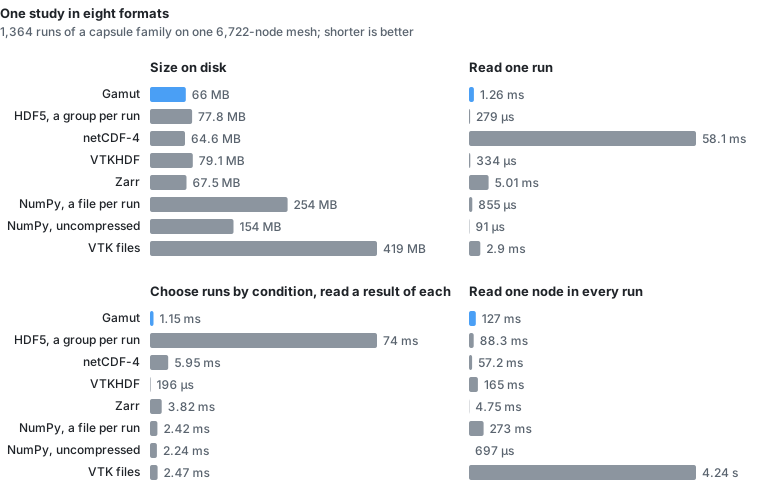
Gamut is about the size of netCDF-4 and Zarr, a little smaller than VTKHDF and HDF5 written a run at a time, and a sixth of the VTK files. Choosing runs by condition and reading a result of each takes about a millisecond, as fast as a Parquet file of the run table alone. Opening a file costs Gamut about 0.9 ms, so HDF5 and VTKHDF read straight with h5py fetch one small run faster, and uncompressed NumPy arrays, at 2.3 times the size, read fastest of all. Gamut's chunks are laid out for reading whole runs, so one node across every run takes 127 ms, slower than Zarr or netCDF-4. HDF5 decompresses on one core; with threads turned on, Gamut fetches the compressed chunks of a whole-run or contiguous read through HDF5 and decompresses them in parallel, and four threads bring that read to 39 ms. On 100 runs of AirfRANS, each on its own mesh of about 176,000 nodes, one run reads in 15 ms against 124 ms from its VTK file.
Apple M3, 8 GB, macOS 27, files in the operating system's cache; medians of five reads, each opening the file. The benchmarks page has every number, the method and the scripts to repeat it.
| Language | Install |
|---|---|
| Python 3.10 or later | pip install gamut-format |
| MATLAB | build_mex(core) once in the matlab folder of a checkout |
| Julia 1.9 or later | Pkg.add(url="https://github.com/bijective-systems-org/gamut", subdir="julia") |
| C++ and C | CMake build and install, then find_package(gamut); include gamut/gamut.hpp (C++17) or gamut/gamut.h (C) |
The Python wheels for macOS, Linux and Windows contain the core with HDF5
linked in. MATLAB and Julia use the same core: the wheel's
(gamut.library_path() prints where it is) or one built with CMake.
Installing has the details for each language.
The guide has one short page per concept, each
running one script from examples/. The
specification defines the format for anyone writing another
implementation, and how it compares sets Gamut
beside VTK, CGNS, Exodus, netCDF-CF and Zarr.
Before version 1 the format was called mestra. Its files (mestra/0) are
refused with their version named; its 0.1 releases stay on PyPI under that
name.
Apache 2.0. Made by Bijective Systems. If you use Gamut in published work, please cite it (CITATION.cff).