
A Pi harness setup, built to specification.


Website · Documentation · Evaluations · Releases
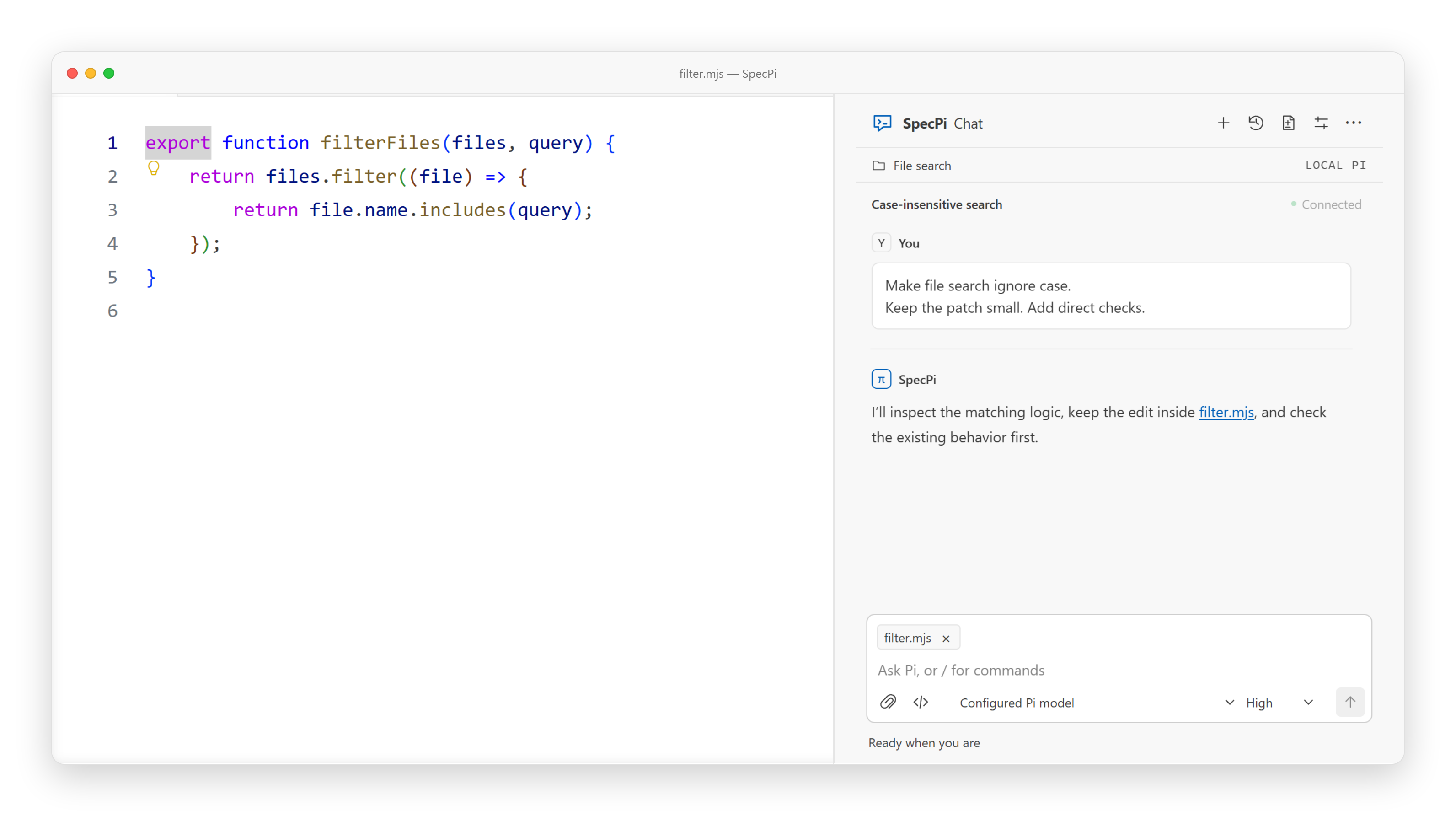
SpecPi Chat · Example workspace
SpecPi 0.37.0 is a small starting point for the Pi coding agent. It is one opinionated setup for how the agent should work, not a marketplace of plugins.
At the center are two built-in extensions. Scope control keeps each task to the files it said it would touch. The improvement loop turns repeated friction into small, tested changes to the setup, instead of letting prompts and workarounds pile up. Around those are eight hand-picked packages, each locked to an exact version and checked before anything installs, plus SpecPi Chat, a VS Code panel for working alongside the agent.
It focuses on five things:
- Control: clear scope, tool permissions, and lifecycle commands that ask before they change anything
- Accuracy: exact version pins, checksums on state, rollback on failure, and proof over promises
- Improvement: local notes become small, checked changes through
/harness-improvement - Efficiency: delegation, persistent goals, and browser QA handled by the right tool for the job
- Keep talking: long evals, builds and servers can run as background jobs, so the conversation is not stuck until they finish. The agent hears back when each one ends, and
/jobslists or stops them - Lean default: web access, browser QA, and delegation stay off until you need them. Turn them on for a session with
/webaccess on,/browser on, and/delegate on— or let the agent ask when it hits the need, and answer the prompt
Everything it touches is written down, versioned, and easy to undo.
Before the agent runs a shell command, LANCET Nano, a 111M-parameter classifier, can check it on your own CPU. It reads Bash, PowerShell and cmd, takes about 10 ms for a typical command, needs no API key, sends nothing over the network, and costs nothing per check. Fixed rules settle the obvious cases first, blocking rm -rf / and passing git status, and the model scores the rest. A risky or uncertain verdict asks you before anything runs; /lancet-guard mode block blocks risky ones outright instead.
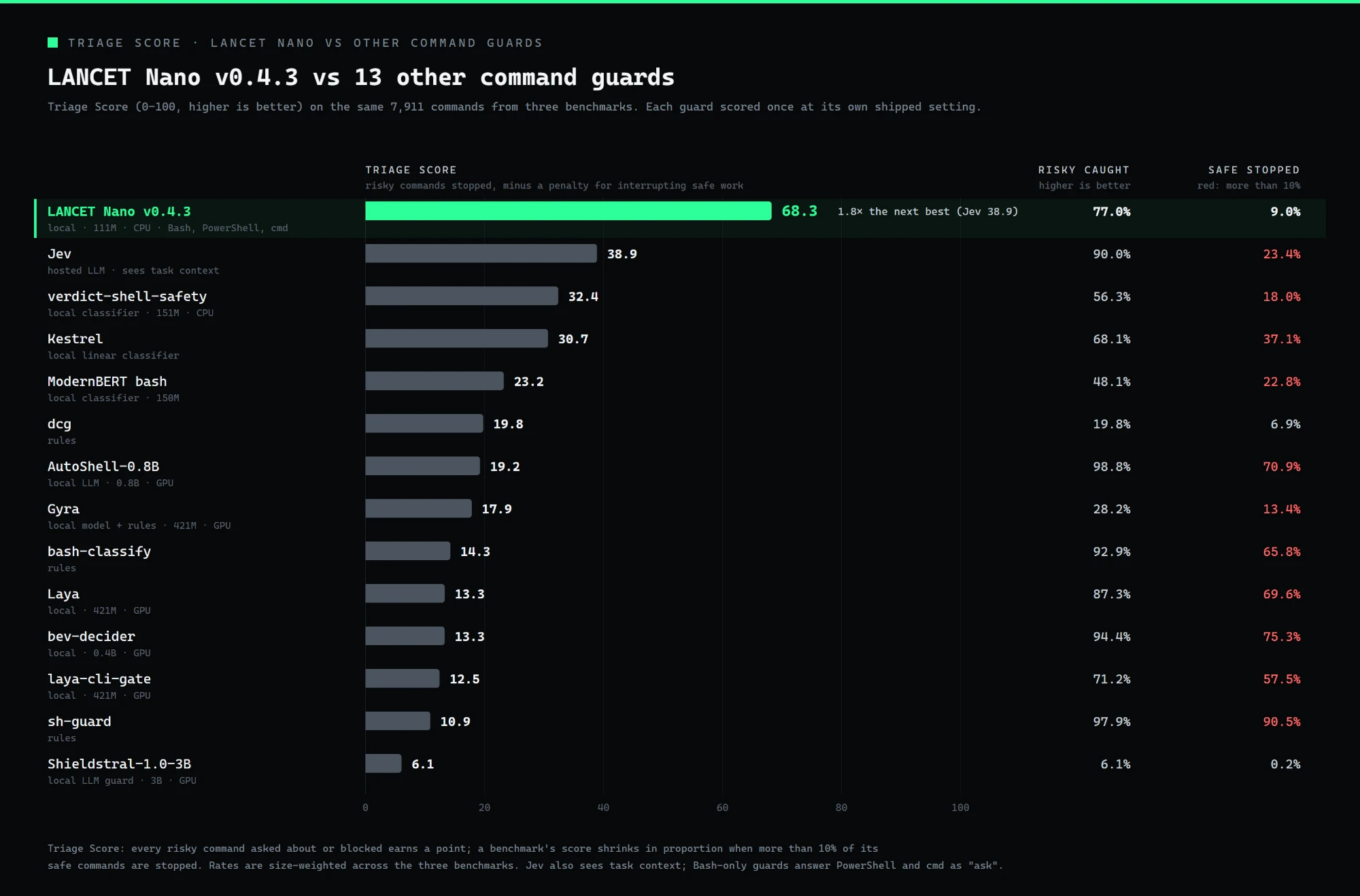
Every guard in the chart was scored once, at its own shipped setting, on the same three benchmarks, 7,911 commands in total, weighted by size: lancet-bench-2-next (1,602 risky commands and their safe look-alikes), the ShellRisk-Bench test split, and a 513-command neutral set. The Triage Score gives a guard a point for each risky command it asks about or blocks, and shrinks in proportion once it stops more than 10% of safe commands. The guard ships off. Run /lancet-guard setup in Pi once to download the model (about 109 MB, verified by SHA-256) and switch it on. How it works, what it costs, and its limits.
This chart shows first-call context from a clean install: all eight pinned packages, the working agreement, and the skills Pi finds, in an interactive session with wishlist collection undecided. A headless session, or one with collection off, also leaves out the gap report and capability request tools. "Enabled" means browser QA, delegation, and web access are switched on, with no goal, scope, or improvement selection active.
The solid rows are measured by us, from the request each setup actually sends through one local test provider. That includes OpenCode, the DeepSeek Harness, and Oh My Pi, all measured as installed. The faded Codex CLI and Claude Code rows come from HarnessTax's published numbers, measured under their own setup. Treat those as a rough reference, not a head-to-head test. These are character counts. They say nothing about tokens, cost, or how well each tool does the job. The research page breaks down the enabled setup by feature, so you can see what each switch costs on its own.
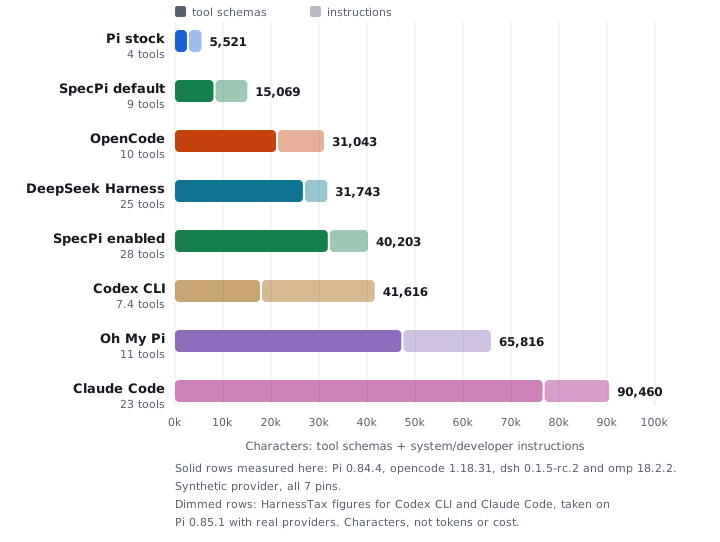
Measured tool schemas + system/developer instructions · node scripts/measure-context.mjs --chart --omp=<path to Oh My Pi's cli.js> --oc=<path to OpenCode's binary> --dsh=<path to the DeepSeek Harness bin> · Recorded measurements and package pins · Method and caveats
The gap between the two SpecPi bars comes from a few separate switches, so the enabled tools are also measured group by group. For example, the fourteen browser QA tools add up to less than the four web access tools:
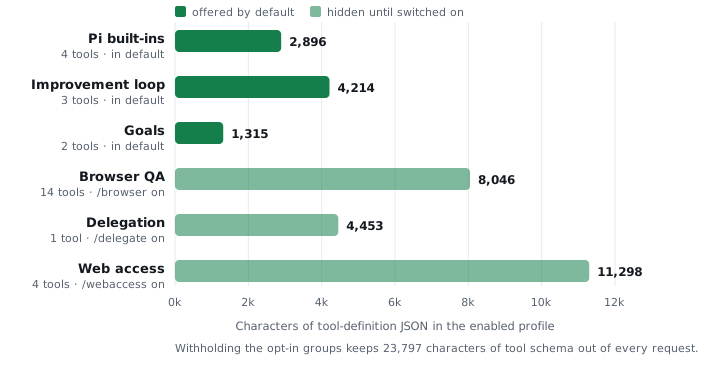
Every tool in the measured request belongs to exactly one group · Leaving all three opt-in groups hidden keeps 23,797 characters of tool schema out of every request
The chart above counts characters. It says nothing about what a harness costs to actually use, or whether it finishes the job. That is what the evals are for: Terminal-Bench 2.0, the same model and the same frozen price list, with only the harness changing.
947 scored attempts on two benchmarks and 6 harnesses,
all on deepseek-v4.1-flash. SpecPi is the published 0.33.0 release, with the experimental Jev layer off.
SWE-bench Verified, 12 tasks × 3: SpecPi solved 34/36 against Pi's 34/36 (p = 1.00), with 2% more prompt tokens and 1% less cost per attempt.
Terminal-Bench 2.0, 731 attempts across 20 tasks:
| Harness | Solved | Rate | Cost/attempt | Prompt tokens | Cache hit |
|---|---|---|---|---|---|
| OpenCode | 29/39 | 0.744 | $0.0124 | 494,173 | 96.5% |
| SpecPi | 62/77 | 0.805 | $0.0144 | 407,416 | 92.4% |
| Pi (base) | 164/230 | 0.713 | $0.0155 | 436,214 | 92.9% |
| DeepSeek Harness | 21/38 | 0.553 | $0.0226 | 1,126,586 | 95.4% |
| Oh My Pi | 115/151 | 0.762 | $0.0237 | 1,108,076 | 96.5% |
| Claude Code | 81/112 | 0.723 | $0.0273 | 670,828 | 95.4% |
SpecPi and Pi ran side by side in the 24 Sep · a sitting. SpecPi solved 30/38
against Pi's 25/39 (Fisher p = 0.21), sending 16% fewer prompt tokens and costing
22% less per attempt. On sanitize-git-repo, with that sitting's extra attempts, SpecPi solved
10/10 against 3/10 (p = 0.003); fix-git was 10/10 for both.
Overall solve rate is a different matter: one sitting cannot rank harnesses here. Bare Pi, on unchanged software and the same thirteen tasks, spans 56-77% across 5 sittings, a wider gap than any measured between two harnesses. Pooled across sittings, SpecPi leads DeepSeek Harness (p = 0.007) and Oh My Pi leads DeepSeek Harness (p = 0.015), but pooling sets one harness's sittings against another's. Cost is recomputed from recorded tokens against a dated price file, never taken from a harness's self-report.
This run is still in progress. See the results and brief method on the
evaluations page. The table above is regenerated
from the run data by node scripts/tb2-site.mjs, so it cannot drift from the
published figures.
Requires Node.js 22.19+, Git, npm, and an existing Pi installation on PATH. The base is tested with Pi 1.0.0.
npm install --global specpi@latest
specpi plan
specpi install
specpi doctor
plan shows what will change without modifying anything. Restart Pi after install.
Install also turns on Pi's built-in codemode tool, which lets the model run a short sandboxed script that calls several tools at once. It does this by adding +codemode to defaultTools in Pi's settings.json, only on Pi 0.99 or later. To keep it off, put -codemode there instead; SpecPi leaves an existing choice alone, and uninstall removes only the entry it added.
Full setup options, package details, and requirements: website.
| Packages | The eight pinned packages and what each provides |
| Scope control | /scope commands and drift monitoring |
| Command guard | LANCET, the local classifier that checks shell commands before they run |
| Improvement loop | Local wishlist, /harness-improvement, and retirement with evidence |
| SpecPi Chat | VS Code frontend and VSIX install · Chat guide |
| Updating | Update, uninstall, and migration notes |
npm install --ignore-scripts --omit=peer --no-package-lock
node --test tests/workflow-controls.test.mjs tests/workflow-controls-extension.test.mjs
npm run check
Installer tests use disposable Pi directories — never test against a live Pi installation. Publication follows the release procedure.
Security model · Third-party components · Release notes · MIT License