


Statistically verified refinement of probabilistic programs with literature-grounded agents and a deterministic MCMC verifier.
COMPASS is a verifier-first system for refining Bayesian models. LLM agents diagnose model weaknesses, search the statistical literature, propose evidence-grounded refinements, and synthesize candidate probabilistic programs. Initially meant for Stan and Numpyro, its current implementation is numpyro heavy. A separate deterministic verifier fits the baseline and candidate models with NUTS and decides whether a proposed refinement is supported by the data.
The central design principle is the separation of the proposal of revisions and the acceptance of them by a statistical referee. In simple terms, agents propose and statistical evidence decides.
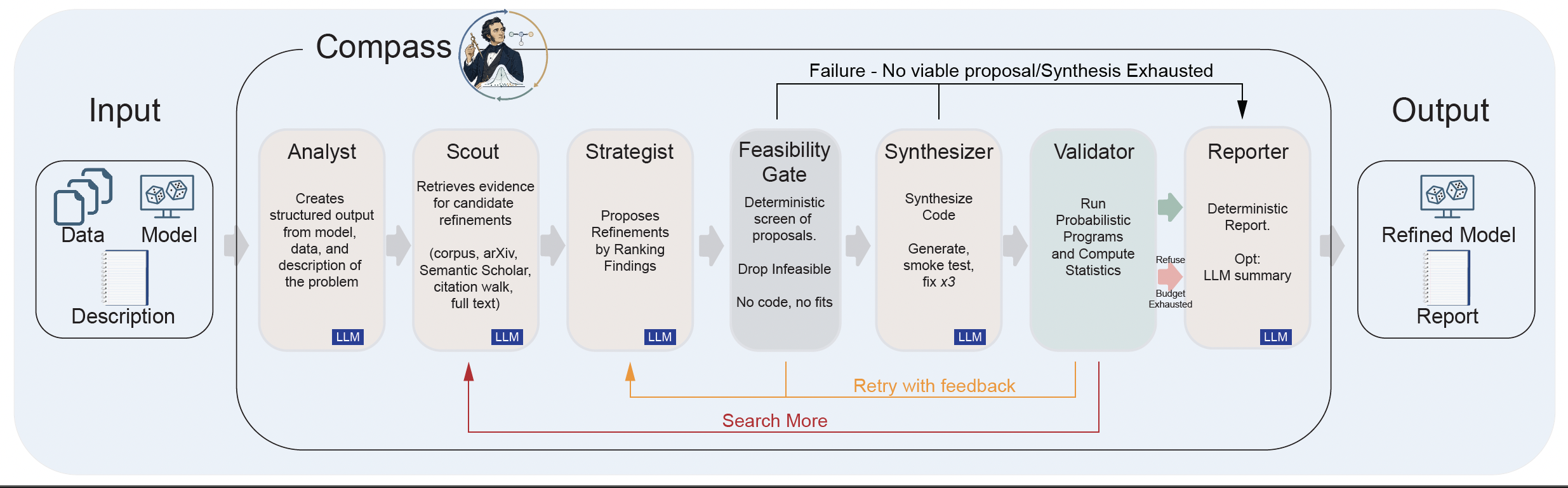
COMPASS takes three inputs:
- a dataset,
- a working Bayesian model implemented as a NumPyro program, and
- a plain-language description of the observed symptoms of model misspecification, not the desired fix.
Four LLM-based agents then act as methodology-aware collaborators:
- Analyst: diagnoses potential weaknesses in the current model.
- Scout: searches the statistical literature for relevant methods.
- Strategist: converts the diagnosis and retrieved evidence into ranked, falsifiable refinement proposals.
- Synthesizer: implements candidate NumPyro programs.
A reporter assembles the results into a complete run report. Reporting is deterministic by default, with an optional LLM-generated narrative available through report_llm=.
Model acceptance is handled separately by a deterministic verifier, not by an LLM. The verifier fits both the baseline and candidate models with NUTS and evaluates a fixed statistical acceptance rule based on:
- posterior-computation diagnostics,
- cross-validated predictive improvement,
- posterior predictive checks, and
- predictive-comparison reliability diagnostics.
A refinement is accepted only when it satisfies these predefined statistical criteria. If no candidate clears the acceptance threshold, COMPASS retains the original model and reports that no supported refinement was found.
Rejections are also first-class outputs. Each failed validation returns specific diagnostic reasons that can inform the next round of proposals. This separation between proposal and acceptance is the core design principle of COMPASS: LLM agents can generate and implement candidate refinements, but they do not decide whether those refinements are supported by the data.
- The verifier has no LLM in it. Acceptance is a deterministic predicate over MCMC fits
(gates G, S, P, R; see
AGENT_GUIDE.mdfor the full contract). - Reliability-gated comparison. When importance-sampled LOO is untrustworthy (Pareto
k̂ > 0.7), the comparison auto-escalates to an exact-refit instrument, unit-level K-fold CV
when per-unit structure is derivable, otherwise exact refits of the influential points
(
reloo), and the instrument itself must pass fold-level convergence gates (R-hat) before any verdict is issued. Deeper instruments (up to leave-one-unit-out) are available explicitly viacv_spec. An infinite Pareto k̂ (what arviz returns for degenerate importance weights, for example from a masked observation) is treated as unreliable, never as a pass: it escalates like k̂ > 0.7 does and, when neither exact-refit rung re-adjudicates the comparison, refuses withPSIS unreliable: refined-model Pareto-k-hat is inf (degenerate importance weights). A NaN k̂ means the tail could not be estimated and does not gate; the repair clause, which needs positive evidence of a reliable comparison, is barred by both. - Observation-set checks. The two fits must score the same observed data, and the check
is comparative: the candidate's observed sites are compared with the baseline's. A mask
that both programs share (the data's own missingness, declared the same way on both sides)
is allowed. A candidate that masks part of the observations on its own (
numpyro.handlers.mask,Distribution.mask, theobs_mask=keyword ofnumpyro.sample) or scales an observed site (handlers.scale) when the baseline does not, that cannot be traced on the data, whose observed variables, shapes or values differ from the baseline's (values compared at float32 tolerance; one renamed observed site is allowed when its shape and values are identical), whose pointwise log-likelihood is degenerate where the baseline's is not (a column constant across draws or non-finite, the signature of a masked or clamped point), or whose likelihood parameters depend on the observed response when the baseline's do not (a two-faced likelihood that lets points opt out of the comparison without a mask) is refused before any comparison is made, with a failure reason that startsmodel comparison refused:and never an ELPD number; no escalation and no repair clause runs on it. No candidate can "improve" by changing what is being predicted. - Repair-equivalence clause. A candidate that fixes computation while provably leaving predictions unchanged (TOST within ±4 nats) can be certified as a repair rather than rejected for not "improving".
- Honest nulls. When nothing clears the bar, the run terminates with no accepted
refinement and the original model deploys unchanged; the report says so plainly (the
terminal status is
failed, i.e. "no validated improvement", which for an adequate model is the correct answer). - Literature grounding. Proposals cite retrieved papers (local corpus + optional live arXiv / Semantic Scholar), but provenance never enters the acceptance predicate.
The repository is public from release 0.3.0 at https://github.com/M-Lab-Repo/compass. The distribution
name is compass-refine (the import name is compass); pip install compass-refine will
work once published on PyPI; the name is reserved for a later upload. Until then, install
from GitHub or from a clone:
# from GitHub
pip install git+https://github.com/M-Lab-Repo/compass.git
# extras from GitHub use the direct-reference form
pip install 'compass-refine[providers] @ git+https://github.com/M-Lab-Repo/compass.git'

# from a clone
git clone https://github.com/M-Lab-Repo/compass.git && cd compass
pip install -e '.[dev]'          # the package plus pytest and ruff, to run the tests
pip install -e '.[providers]'    # plus the OpenAI and Google clients for get_llm(provider="openai" | "google")
pip install -e '.[figures]'      # plus matplotlib, Pillow and pypdf for the figure code under figures/ (drawing; the run and score steps need only the package)
Python ≥ 3.10. Heavy dependencies: jax, numpyro, arviz, langgraph, langchain-anthropic.
Tested environment: Python 3.10.9, numpyro 0.19.0, jax 0.6.2 (CPU), arviz 0.23.4,
langgraph 1.2.x, langchain-core 1.x; constraints.txt pins that environment exactly
(pip install -c constraints.txt -e .). NumPyro >= 0.21 requires Python >= 3.11 (0.20.0 is
the last release for Python 3.10), so on Python 3.10 pip resolves to NumPyro 0.20.0 or
earlier; either works with COMPASS.
Set the API key of the provider you use in the environment or in a .env file in the current
working directory or one of its parents (loaded with python-dotenv): ANTHROPIC_API_KEY
for the default provider, OPENAI_API_KEY for OpenAI, GOOGLE_API_KEY for Google
(GEMINI_API_KEY is accepted as an alias). The agents need a key; the verifier alone does not.
Optional: BAYES_REFINE_PROVIDER selects the provider when no provider argument is given, and
BAYES_REFINE_MODEL, BAYES_REFINE_MODEL_OPENAI, BAYES_REFINE_MODEL_GOOGLE override each
provider's default model (see Choosing the model provider).
One command runs everything. No test needs an API key or network access, and the suite
neutralises any key found in the environment or a .env file. Set JAX_PLATFORMS=cpu so that
JAX does not look for an accelerator.
pip install -e '.[dev,figures]'
JAX_PLATFORMS=cpu python -m pytest tests -m "not slow"   # the package and the figure code
ruff check .                                             # lint; configuration in pyproject.toml
tests/ holds two groups. The package tests at its top level cover the API surface, the graph
flags, the providers, structured output, usage metering, the sync tool, the provenance checker,
the examples and the ported research suites (verifier gates, crossval, repair clause, strategist,
synthesizer, retrieval, judge). tests/figures/ tests the figure code under figures/ and needs
the figures extra (matplotlib, Pillow, pypdf); the directory is collected only when the extra
is installed (tests/conftest.py), so pytest tests passes on a plain pip install -e '.[dev]'
and runs everything after the install line above. The same two steps, the tests and
ruff check ., run in GitHub Actions on Python 3.10, 3.11 and 3.12
(.github/workflows/tests.yml).
The slow marker selects the tests that sample or compile. In the package suite these are the
twelve tests of the verifier round trip of test_smoke.py, the --fast run of
examples/verifier_only.py (test_examples.py), four in test_crossval.py, four in
test_synthesizer.py (two real smoke-test subprocesses and two CmdStan compiles, which skip
without the stan extra), and one each in test_validator_gates.py and
test_repair_clause.py; JAX_PLATFORMS=cpu python -m pytest tests -m slow takes about two
minutes on one CPU core.
No test ships data. Two environment variables point the tests at the data archive (see
"Reproducing the paper's figures and experiments"), and the tests that need them skip
otherwise: COMPASS_ARMS_DIR, the arms/ directory of the benchmark records, makes the tests of
tests/figures/test_figure{2,3,4}.py that read the records run instead of skipping, and
COMPASS_DATA_DIR, the datasets/ directory, points the real-data loaders of figures/bench/
at the vendored datasets. One figure test, the overlay check of the Figure 2 sheet in
test_figure2.py, also needs the optional pymupdf and skips without it. The tests that compare
this tree with the research checkout, tests/figures/test_provenance.py, skip unless one is found
in the parent directory of this repository.
The full pipeline calls a language model, so this example needs ANTHROPIC_API_KEY in the
environment or a .env file (or another provider's key together with llm=get_llm(provider=...),
below); examples/quickstart.py is a seeded, cached version of this example (a fixed random
seed and a cache_dir), ready to run. Runtime: several minutes, most of it MCMC.
import numpy as np
from compass import run_refinement

data = {"y": np.random.negative_binomial(2, 0.3, size=200),  # overdispersed counts
        "n": 200}  # sizes are data, never hardcoded (the synthesizer smoke-tests on dummy shapes)

MODEL = '''
def model(n=None, y=None):
    lam = numpyro.sample("lam", dist.Exponential(0.1))
    with numpyro.plate("obs", n):
        numpyro.sample("y", dist.Poisson(lam), obs=y)
'''

final = run_refinement(
    problem_description="Count outcome with sample variance far above the mean; "
                        "occasional large values. The Poisson baseline may be too rigid.",
    model_code=MODEL,
    data=data,
    max_iterations=2,
)
print(final["report"])
The same run with OpenAI models for every agent (needs OPENAI_API_KEY and the providers extra):
from compass import get_llm
final = run_refinement(..., llm=get_llm(provider="openai"))
Verifier-only (no LLM, no API key): adjudicate a candidate you already have. With data and
MODEL from above as the baseline:
from compass import run_full_validation

original_src = MODEL
candidate_src = '''
def model(n=None, y=None):
    mu = numpyro.sample("mu", dist.Exponential(0.1))
    phi = numpyro.sample("phi", dist.HalfNormal(5.0))
    with numpyro.plate("obs", n):
        numpyro.sample("y", dist.NegativeBinomial2(mu, phi), obs=y)
'''
result = run_full_validation(candidate_src, original_src, data, seed=0,
                             num_warmup=300, num_samples=600, num_chains=2)
print(result.failure_reasons or "accepted")
The complete script is examples/verifier_only.py: it prints the verdict, the failure
reasons, elpd_diff ± se and the wall time. On one CPU core (Python 3.10.9, jax 0.6.2) it
printed verdict: accepted (confidence HIGH) and elpd_diff: -112.99 +/- 23.41 after 11 s of
sampling (14 s in all, JAX import included). --fast halves the budget for a quick check of
the installation; at that budget the baseline's ESS falls below 400 and the verifier refuses to
certify the comparison (original-model fit unreliable (comparison baseline): ESS 292), which
is the budget being judged, not the candidate, which is the reason fast numbers are never verdicts.
All options, by the layer they belong to. Anything not listed here is internal.
| Option | Default | Meaning |
|---|---|---|
problem_description |
required | Observable symptoms, never the fix |
dataset_summary |
"" |
Auto-computed from data (pandas) when empty |
model_code |
"" |
Source of the baseline model function |
framework |
"numpyro" |
"stan" exists behind the [stan] extra, NumPyro is the supported path |
data |
None |
The dataset dict (arrays + size scalars) |
max_iterations |
3 |
Propose→synthesize→validate rounds |
thread_id, recursion_limit |
auto / 50 |
LangGraph plumbing |
**graph_kwargs |
none | Everything below is forwarded to build_refinement_graph |
| Option | Default | Meaning |
|---|---|---|
llm |
get_llm() |
Shared model for all agents |
analyst_llm / scout_llm / strategist_llm / synthesizer_llm |
llm |
Per-agent overrides (mix model tiers, or inject FixtureLLM in tests) |
report_llm |
None |
Reporter narrative LLM; deterministic report when unset |
scout_kwargs |
{} |
See scout options below |
synthesizer_kwargs |
{} |
max_attempts (default 3): synthesis retry budget per candidate; data: smoke-test candidates on these real arrays instead of dummy data derived from the recorded shapes; guard_replicate_sites: add the NumPyro site guard to the synthesizer prompts; validator: inject a (code, data_shapes) -> verdict dict check in place of the NumPyro smoke test |
validator_kwargs |
{} |
See validator options below |
strategist_directive |
"" |
Extra standing instruction appended to the strategist prompt |
hint_level |
"structure+ladder" |
Diagnostic-hint verbosity fed back to the strategist: "none" | "structure" | "structure+ladder" |
verdict_only |
False |
Benchmark arm. Redacts the verifier's feedback to the proposer: after a refused candidate the feedback_history entry carries the iteration number and verdict_only: True with every other field empty (no failure reasons, LOO or PPC numbers, failed predictions, diagnostic hints or proposal names, so the deterministic DO-NOT-PROPOSE ban bans nothing). The validator still runs in full and candidate_history keeps every verdict |
smoke_on_data |
False |
With data given (run_refinement passes its data through), the synthesizer's smoke test runs candidates on the real arrays instead of dummy data derived from the recorded shapes; dummies turn integer count and index columns into negative floats, which fails every candidate that uses them semantically. Forwarded as synthesizer_kwargs["data"]; an explicit entry there wins |
guard_replicate_sites |
False |
The synthesizer's prompts carry the NumPyro site guard (no unobserved replicate or discrete sample sites, which NUTS cannot sample) and its fix prompt gets a targeted hint on such errors. Forwarded as synthesizer_kwargs["guard_replicate_sites"]; an explicit entry there wins |
checkpointer / interrupt_before |
None |
LangGraph checkpointing / human-in-the-loop pause points |
Every validated candidate is appended to WorkflowState.candidate_history (iteration, source,
proposal names and rationale, passed, the ValidationResult), independently of verdict_only.
| Option | Default | Meaning |
|---|---|---|
provider |
None |
"anthropic", "openai" or "google"; None means BAYES_REFINE_PROVIDER, else "anthropic" |
model |
None |
Model identifier; None means the provider's model variable (BAYES_REFINE_MODEL, BAYES_REFINE_MODEL_OPENAI, BAYES_REFINE_MODEL_GOOGLE), else the provider default (claude-sonnet-4-6, gpt-5, gemini-3.1-pro-preview) |
temperature |
0.0 |
Sampling temperature. Not sent to OpenAI reasoning models (the o-series and gpt-5* ids other than the gpt-5-chat* chat models), which reject it |
max_tokens |
8192 |
Output cap. Raised to at least 32768 for OpenAI reasoning models, whose reasoning tokens count against it |
timeout |
120.0 |
Seconds before a stalled request fails instead of blocking the pipeline |
max_retries |
2 |
Client-side retries of transient errors and timeouts |
On OpenAI, with_structured_output uses function calling (method="function_calling",
strict=False) rather than the strict JSON-schema response format, which rejects the project's
nested pydantic schemas; callers that pass method or strict explicitly win. A missing key
raises RuntimeError naming the variable; a missing client package raises RuntimeError naming
the package (langchain-openai, langchain-google-genai; both are in the providers extra).
| Option | Default | Meaning |
|---|---|---|
cache_dir |
None |
Content-addressed fit cache (code, data, budget, seed); set it |
seed |
0 |
Harness seed for every fit |
fast |
False |
Tiny budgets for smoke tests; never a verdict |
num_warmup / num_samples / num_chains |
spec defaults | MCMC budget (run_full_validation only; in the pipeline use a validation_fn closure, see skill/scripts/run_refinement.py) |
target_accept |
0.8 |
NUTS target acceptance (run_full_validation only) |
cv_spec |
None |
Explicit cross-validated S gate in place of PSIS-LOO, as a dict {"spec": CVSpec(...), "scheme": "kfold", "K": 5, ...}. "spec" is a compass.crossval.CVSpec declaring the exchangeable unit (per_unit_keys, local_latents, obs_site, obs_kwarg, unit_size_keys, shared_keys, unit_axis, per_unit_axes, plate); every other key is forwarded to crossval_compare: scheme ("kfold", "split" or "entry_mask"), K (folds; capped at the number of units, so K = the unit count is exact leave-one-unit-out), split_frac (held-out fraction of the "split" scheme), budget (a (warmup, samples, chains) triple for the fold fits, default (400, 800, 2)), s_use and r_prior (posterior draws and prior draws used when marginalising the local latents of a held-out unit). Required to reach deep instruments such as leave-one-unit-out; worked example below. In the pipeline, applied only with the default run_full_validation |
auto_cv |
True |
Allow the one-step automatic escalation (PSIS → unit K-fold or reloo) on a Pareto-k̂ failure. In the pipeline, applied only with the default run_full_validation |
repair_clause |
True |
Enable the repair-equivalence verdict. In the pipeline, applied only with the default run_full_validation |
compute_heldout |
False |
Pipeline only (not an argument of run_full_validation). After a candidate passes, score a descriptive held-out split on that winner and attach it as result.heldout; it never changes acceptance, and it is marked unavailable when the S gate was already cross-validated (cv_spec set or an escalated instrument used). Requires the default run_full_validation, NumPyro and real data |
validation_fn |
None |
Full replacement of the validation call (the budget-override hook) |
A worked cv_spec: a hierarchical model of J schools whose per-school effect theta is a
local latent, certified by exact leave-one-school-out (K equal to the number of units). Each
fold refits both models without one school and scores that school with its latent marginalised,
so the cost is J refits per side; set cache_dir so that retries never resample a fit.
from compass import run_full_validation
from compass.crossval import CVSpec

# data = {"y": (J,) array, "sigma": (J,) array, "J": J}; the model reads y, sigma and J
spec = CVSpec(per_unit_keys=["y", "sigma"],   # arrays sliced along the school axis when folding
              local_latents=["theta"],         # per-school sites, marginalised for a held-out school
              obs_site="y", unit_size_keys=["J"], plate="school")
res = run_full_validation(candidate_src, original_src, data, seed=0, cache_dir=".compass_cache",
                          cv_spec={"spec": spec, "scheme": "kfold", "K": data["J"]})
print(res.s_gate, res.elpd_diff, res.elpd_diff_se, res.failure_reasons)
A custom validation_fn is called as fn(refined_code, original_code, data, framework=, fast=, cache_dir=, seed=, proposals=) and nothing else: cv_spec, auto_cv, repair_clause and
compute_heldout are not forwarded to it, so a replacement that wants them must pass them to
run_full_validation itself. Accept **kwargs so that future keywords do not break the call
(skill/scripts/run_refinement.py shows the pattern).
| Option | Default | Meaning |
|---|---|---|
live |
False |
Turn on live retrieval (arXiv + Semantic Scholar) on top of the local corpus |
corpus |
None |
Curated paper list for the local index; falls back to the bundled 15-paper test fixture (with a logged warning) |
max_findings |
5 |
PaperFindings forwarded to the strategist |
score_drop / score_fetch |
6 / 8 |
Applicability-score thresholds: below score_drop a paper is dropped; at score_fetch+ its method excerpt is attached |
min_findings |
0 |
Trigger the query-decomposition fallback when fewer survive |
paper_finder_enabled |
False |
Extra Semantic Scholar paper-finder channel (needs an API key, see below) |
embedder / store / applicability / extraction / paper_finder |
None |
Dependency-injection points (custom embeddings, vector store, scoring) |
Each retrieved paper is scored by a structured applicability call to the scout's LLM. When the
reply does not fit the schema after the structured-output retries (see
below), the paper is treated as not applicable
(score 0, every boolean false) instead of failing the run; the parsing error is kept in the
verdict's effort_to_improvement field.
| Variable | Needed for | Notes |
|---|---|---|
ANTHROPIC_API_KEY |
the default provider's agents | Verifier-only runs need none |
OPENAI_API_KEY |
provider="openai" |
Needs the providers extra |
GOOGLE_API_KEY |
provider="google" |
GEMINI_API_KEY is accepted as an alias (copied into GOOGLE_API_KEY when that is unset); needs the providers extra |
BAYES_REFINE_PROVIDER |
optional | Provider used when get_llm receives no provider argument: anthropic, openai or google |
BAYES_REFINE_MODEL |
optional | Override the default Anthropic model |
BAYES_REFINE_MODEL_OPENAI / BAYES_REFINE_MODEL_GOOGLE |
optional | Override the default OpenAI / Google model |
S2_API_KEY |
optional, live scout | Semantic Scholar Graph API key, sent as the x-api-key header on every Semantic Scholar channel (search, citations, paper finder) |
ASTA_API_KEY |
optional, live scout | Alternative Semantic Scholar (Asta) key; used for every Semantic Scholar channel when S2_API_KEY is absent |
Every variable may also be set in a .env file in the current working directory or one of its
parents (loaded with python-dotenv when get_llm runs, through find_dotenv(usecwd=True):
the search starts at the working directory, never at the installed package's own directory).
scout_kwargs={"live": True} enables two live channels. arXiv needs no key. Semantic
Scholar works keyless on the shared public rate limit; an API key gives you a dedicated limit,
and the optional paper-finder channel (paper_finder_enabled=True) stays off entirely
unless a key is present. All live channels are throttled (one call per 2.5 s to Semantic
Scholar, per 3 s to arXiv), retried once on a 429 (after the server's numeric Retry-After
when it is within the 30 s cap, else after a fixed backoff; a Retry-After beyond the cap skips
the retry) and degrade to empty results rather than failing the run.
- Request a free Semantic Scholar key at https://www.semanticscholar.org/product/api (or use an Asta key if you have one).
- Put the keys in a
.envfile in the current working directory or one of its parents (loaded withpython-dotenv), or export them:
# .env
ANTHROPIC_API_KEY=sk-ant-...
OPENAI_API_KEY=sk-...           # only for provider="openai"
GOOGLE_API_KEY=...              # only for provider="google" (GEMINI_API_KEY also works)
BAYES_REFINE_PROVIDER=anthropic # optional: default provider when get_llm() gets none
S2_API_KEY=...          # optional: dedicated Semantic Scholar rate limit
ASTA_API_KEY=...        # optional alternative, used for every Semantic Scholar channel when S2_API_KEY is absent
final = run_refinement(..., scout_kwargs={"live": True}) # arXiv + S2
final = run_refinement(..., scout_kwargs={"live": True, "corpus": my_papers}) # + your corpusget_llm builds the chat model that every agent shares, or a per-agent override. Precedence
for the provider: the provider argument, then BAYES_REFINE_PROVIDER, then anthropic. For
the model identifier: the model argument, then the provider's model variable
(BAYES_REFINE_MODEL, BAYES_REFINE_MODEL_OPENAI, BAYES_REFINE_MODEL_GOOGLE), then the
provider default (claude-sonnet-4-6, gpt-5, gemini-3.1-pro-preview). The OpenAI and
Google clients come from the providers extra.
from compass import get_llm, run_refinement

final = run_refinement(..., llm=get_llm(provider="google"))                             # every agent
final = run_refinement(..., synthesizer_llm=get_llm(provider="openai", model="gpt-5"))  # one agent
The verifier never calls an LLM. The provider therefore affects the analyst, scout, strategist
and synthesizer (and the optional report_llm narrative), plus the evaluation-only judges in
compass.judge, which read code and are never wired into acceptance. The acceptance predicate
and its gates are identical under every provider.
Structured output and its retry contract. Every agent call asks the model for a reply typed
by a pydantic schema. A reply that does not fit (missing or mistyped fields, a list serialized
as a string, no tool call at all) is retried STRUCTURED_RETRIES (2) more times, each time with
a schema reminder appended to the prompt. Once the retries are spent:
- the analyst and the strategist raise
StructuredOutputError, which propagates out ofrun_refinement(the message names the schema and the last parsing error); - the synthesizer gives up on the current candidate: the failure is appended to
error_logas a synthesis failure andrefined_model_codeis left empty, so the graph skips validation and goes straight to the report (the run ends there); that candidate was never adjudicated; - the scout treats the paper whose applicability reply could not be parsed as not applicable (score 0) and continues.
These are plumbing failures of the provider and should be reported as such, never as evidence about the model or the proposal.
An all-rejected round. After the strategist's reply is parsed, a deterministic
post-validation drops any proposal whose name matches a technique already recorded as failed in
feedback_history (the DO-NOT-PROPOSE ban), whose change_type is invalid, or that cites no
finding while findings exist. When nothing survives, the node returns an empty bundle instead
of raising: error_log gets a line starting strategist: post-validation rejected every proposal (compass.agents.strategist.EMPTY_BUNDLE_LOG_PREFIX), the feasibility gate books a
failed iteration whose feedback entry names no technique, and the graph retries the strategist
within max_iterations or goes to the report. The DO-NOT-PROPOSE bullet the next round sees
names every banned technique of each entry (tried and all of tried_all), the same list the
ban enforces.
Metering. track_usage counts every chat-model call made inside its block, on any provider
and any model built anywhere (including the judges and a FixtureLLM(usage=(i, o)) test
double), with no handler attached to the models themselves:
from compass import run_refinement, track_usage

with track_usage("refinement") as usage:
    final = run_refinement(...)
print(usage.snapshot())
# {"calls": ..., "input_tokens": ..., "output_tokens": ..., "total_tokens": ...,
#  "seconds": ..., "calls_without_usage": ..., "errors": ..., "by_model": {model_id: {...}}}
by_model is keyed by the requested model identifier. Nested blocks count toward their
enclosing ones exactly once. UsageTracker is the handler class behind the context manager,
for callers that want to hold the tracker directly.
run_refinement executes Python written by a language model on your machine. The
synthesizer's smoke test runs each candidate in a subprocess with a scrubbed environment: the
interpreter runs in isolated mode (python -I) with a short allowlist built by
compass.agents.synthesizer.smoke_test_env (PATH, HOME, the locale, TMPDIR, library
paths, the JAX/XLA/CUDA/OpenMP thread knobs and the Windows start-up variables; see
smoke_test_env for the exact names) and every *_API_KEY, *_TOKEN and BAYES_REFINE_*
variable is dropped whatever else matches (PYTHONPATH is not passed through). The validator
then fits the candidate in-process with NUTS (an exec of the source in the calling process).
Neither is a sandbox: the subprocess still has the host's filesystem and network, and the
in-process fit has every privilege of the Python process that called it. Note that -I also
ignores PYTHON* variables and the user site-packages, so NumPyro and JAX must be installed in
the interpreter's own environment (a venv or conda environment, not pip install --user):
the synthesizer probes the interpreter before the first smoke test and raises
EnvironmentError when numpy, jax or numpyro is not importable under -I, instead of
failing every candidate with an import error. Treat a run the way you would treat
running code from a pull request you have not read:
- run COMPASS in a container or VM, especially with live retrieval (
scout_kwargs={"live": True}) or a corpus you did not curate, since retrieved text reaches the prompts that write the code; - keep nothing in the environment beyond the provider key (and, if you use them, the scout
keys); the fit cache and the
.envfile should hold nothing else of value; - read
final["refined_model_code"]before you deploy it.
The verifier alone (run_full_validation, skill/scripts/verify_candidate.py) executes only
the two programs you pass it.
Everything that reproduces the paper's figures is under figures/, documented in
figures/README.md: the
per-panel scripts of Figure 2 (figures/figure2/), Figure 3 (figures/figure3/) and the cost
figure, Supplementary Fig. 1 (figures/figure4/), each panel with a run, a score and a create
step, copied from the research tree by tools/sync_figures.py with the imports of the pipeline
rewritten to the installed package (figures/provenance.json is their manifest); the four
benchmark modules the run and score steps import (figures/bench/); the driver
figures/render.py, which writes the eleven vector PDFs of the manuscript from the committed
records; and the checker figures/compare_pdf.py, which compares a render with
figures/reference_manifest.json.
The scripts read the benchmark records, which are not in this repository. They are published as
an asset of the GitHub release v0.3.0, compass_benchmark_records_v0.3.0.zip
(https://github.com/M-Lab-Repo/compass/releases/download/v0.3.0/compass_benchmark_records_v0.3.0.zip):
arms/ holds 18 arm directories and 13 <arm>_summary.json files (738 JSON files, about 57 MB;
one record per pipeline run, the drift trajectories under <arm>/drift/), datasets/ the seven
vendored textbook datasets of the real-data arms, and CHECKSUMS.sha256 the SHA-256 of every
file (sha256sum -c CHECKSUMS.sha256 from inside the unpacked directory). Unpack it and give the
scripts its arms/ directory with --arms DIR or the environment variable COMPASS_ARMS_DIR
(and its datasets/ directory as COMPASS_DATA_DIR for the real-data loaders). Rendering needs
no key and takes seconds:
pip install -e '.[figures]'      # or pip install -r figures/requirements.txt for the reference versions
python figures/render.py --list                                           # the eleven names
python figures/render.py --arms /path/to/arms --out /path/to/out          # all eleven files
python figures/render.py --arms /path/to/arms --out /path/to/out --only fig2a,fig2b,fig2c,fig2d,fig2_composite
python figures/render.py --arms /path/to/arms --out /path/to/out --png    # also <name>.png (200 dpi)
python figures/compare_pdf.py --rendered /path/to/out --reference figures/reference_manifest.json
render.py [--arms ARMS] [--out OUT] [--only ONLY] [--list] [--png] writes, in this order,
fig2a_editable.pdf, fig2b_editable.pdf, fig2c_editable.pdf, fig2d_editable.pdf and
fig2_composite_editable.pdf (Figure 2), fig3a_editable.pdf, fig3b_editable.pdf,
fig3c_editable.pdf, fig3d_editable.pdf and fig3_composite_editable.pdf (Figure 3) and
fig4_cost_editable.pdf (Supplementary Fig. 1); --out defaults to figures/out/ (ignored by
git), a composite needs its panels in --out, and the exit status is 0 only when every selected
file was written. The driver sets SOURCE_DATE_EPOCH for the render, so the creation date
matplotlib writes into each PDF is fixed and renders of the same records in the reference
environment (figures/requirements.txt) are byte-identical across machines.
compare_pdf.py [--rendered RENDERED] --reference REFERENCE [--names NAMES] compares the
rendered PDFs with a directory of reference PDFs or with the manifest, dates aside (a PDF
embeds the time it was written); --write-manifest PATH --source-label TEXT writes a manifest
of --reference instead.
The experiments themselves are re-run from the same directories, from scratch: for every panel,
figures/figureN/figureNx_run.py calls the models and writes one raw record per pipeline run
(figures/figure2/figure2_run.py is the census engine, figures/figure3/figure3_run.py the
drift engine), figureNx_score.py adds the held-out labels by MCMC and the independent readers'
verdicts in side files, and figureNx_create.py counts and draws; the per-figure READMEs state
the arms, the keys, the compute and the cost of each step. --dry-run prints every run and
needs no key; a real re-run needs the provider keys (in the environment or in figures/.env),
the vendored datasets for the real-data arms (COMPASS_DATA_DIR), and for Figure 2 alone 618
runs, about $300-400 of model calls and 25-40 CPU-hours across four parallel shells, plus about
$70 of reader passes. A re-run reproduces the protocol, not the bytes: model replies, verdict
texts and timings differ between runs.
pip install -e '.[providers,figures]'
cd figures
python figure2/figure2a_run.py --out-root runs/2026-11 --dry-run    # the 618 runs of Figure 2
python figure3/figure3a_run.py --out-root runs/2026-11 --dry-run    # the 32 drift trajectories of Fig. 3a and 3b
python figure3/figure3e_run.py --out-root runs/2026-11 --dry-run    # the 28 real-data trajectories of Fig. 3c
python figure3/figure3c_run.py --out-root runs/2026-11 --dry-run    # the 21 census runs of Fig. 3d
python figure4/figure4_run.py --out-root runs/2026-11 --dry-run # the 295 census runs of the cost figure| Path | What it is |
|---|---|
src/compass/ |
The installable package (graph, state, verifier, cross-validation ladder, agents) |
AGENT_GUIDE.md |
The operating contract for an agent that drives COMPASS on a user's behalf: required inputs, every gate explained, and how to narrate progression honestly |
skill/ |
A Claude skill wrapping this repo (SKILL.md, scripts/run_refinement.py, scripts/verify_candidate.py); drop it into ~/.claude/skills/compass/ |
examples/quickstart.py |
The sixty-second example as a script (needs a provider key) |
examples/verifier_only.py |
The key-free verifier example: Poisson baseline versus NegativeBinomial2 candidate on synthetic counts |
tests/ |
Offline tests. At the top level the package tests: the public API, the graph flags, the provider factory, structured-output retries, usage tracking, the sync tool and the provenance checker, the examples and the skill scripts (test_examples.py), and the ported research suites: the verifier gates (test_validator_gates.py, test_validator_fixes.py), the cross-validation ladder (test_crossval.py), the repair clause (test_repair_clause.py), the strategist (test_strategist.py), the synthesizer and its smoke test (test_synthesizer.py), retrieval (test_retrieval_live.py) and the judges (test_judge.py); the twelve tests that sample or compile carry the slow marker (pytest -m slow) |
tests/figures/ |
The figure code's tests: every panel script, the driver and the comparison tool on synthetic records built inline (figure_records.py) and on the committed records when a data root is present, the run and score steps with stubbed models, and the provenance of the copies against the research tree when it is present; fixtures/ holds one real record of the research benchmark runner |
figures/ |
The single folder that reproduces the paper's figures, from scratch and from the committed records, with its own README |
figures/figure{2,3,4}/ |
The per-panel scripts of Figure 2, Figure 3 and the cost figure (Supplementary Fig. 1): the protocol tables, the census and drift engines, and per panel a run, a score and a create script, with a composer for each of the two multi-panel figures; each directory has a README and a flow diagram |
figures/bench/ |
The four benchmark modules the run and score steps import: the eight synthetic data-generating processes, the seven textbook datasets, the proposer-hidden split and the template controls |
figures/render.py, figures/compare_pdf.py, figures/reference_manifest.json |
The driver that writes the eleven PDFs, the date-neutral comparison with the reference PDFs, and the hashes and sizes of the eleven reference files |
figures/provenance.json |
The manifest of the 43 copied files, checked by tools/check_provenance.py |
tools/sync_from_research.py |
Mirrors the research modules into src/compass/ with the import rewrite and the package-only patches; --check verifies that the tree matches |
tools/sync_figures.py |
Regenerates figures/figure{2,3,4}/ and figures/bench/ from the research tree with the import rewrite; --check verifies |
tools/check_provenance.py |
Compares every copied definition under figures/ with its research source, driven by the provenance manifest named with --manifest |
CITATION.cff, .zenodo.json |
Citation metadata, rendered by GitHub's "Cite this repository", and the metadata of the Zenodo software deposit |
CHANGELOG.md |
What changed in each release |
constraints.txt |
The pinned versions of the tested environment (pip install -c constraints.txt -e .) |
MANIFEST.in, .github/workflows/tests.yml |
The source-distribution contents beyond the package, and the CI workflow that runs the tests and the linter |
We are providing this tool to the community and any and all who want to use it. Issues and
pull requests are welcome at https://github.com/M-Lab-Repo/compass; we read them, but
we cannot promise a response time, and while the package is below version 1.0 its API may
change between minor versions (CHANGELOG.md records every such change).
The paper is in preparation. Until it appears, cite the software: release 0.3.0 is archived on
Zenodo under the version DOI 10.5281/zenodo.24237039
(cite this one); the concept DOI 10.5281/zenodo.24212300
always resolves to the latest archived version. Both are in CITATION.cff, so GitHub's "Cite this
repository" button renders the reference as BibTeX or APA. The benchmark records travel as an asset of the GitHub release (see "Reproducing the
paper's figures and experiments"); Zenodo archives the source tree, not the asset.
COMPASS is released under the Allen Institute Software License. Redistribution and use for commercial purposes require written permission from the Allen Institute.
See LICENSE.txt for the full license terms.