




🇺🇸 English | 🇪🇸 Español | 🇫🇷 Français | 🇮🇹 Italiano | 🇩🇪 Deutsch | 🇨🇳 简体中文 | 🇯🇵 日本語 | 🇵🇹 Português


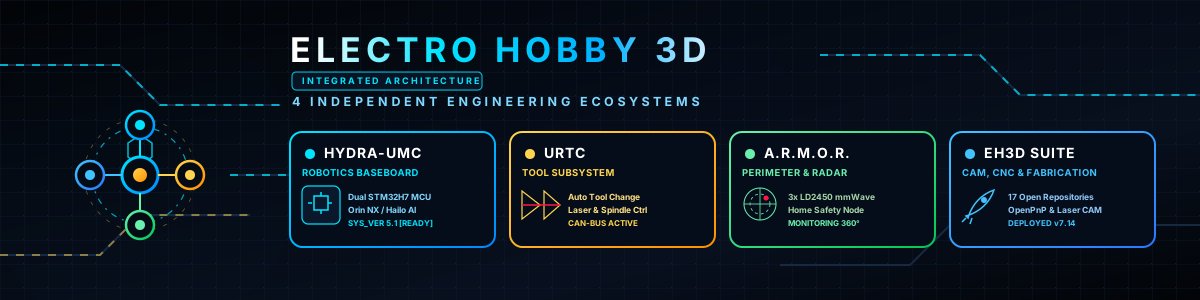
Four independent engineering ecosystems, one author. HYDRA-UMC is a multi-layered industrial robotics platform, from real-time firmware to cognitive AI. URTC is its universal robot-tool subsystem: real-time firmware and desktop/web tooling for a robot's own end-effector, developed as its own product with independent versioning and maintenance tools. A.R.M.O.R. is a separate, public perimeter-security and home-automation ecosystem - radar presence detection, solar and electrical monitoring, and a central coordinator with web and mobile clients. EH3D Fabrication Suite is an integrated software ecosystem for PCB prototyping, CAM processing, computer vision inspection, Pick & Place management, and CNC/Laser control interfacing with HYDRA-UMC hardware and specialized workshop machinery.
Each line is one part of this repository and the light says how far it is today. It is written from what the repository can show (tests, builds, runs), not from what is planned.
🟢 Done and verified · 🟡 Works, with known limits · 🟠 Partly done or not verified yet · 🔴 Not done or not working
| Area | State | What it means here |
|---|---|---|
| Dashboard and monitors | 🟢 | The status dashboard, the CI watch, the health matrix, the link check and the release digest run on a schedule in GitHub Actions, and their latest runs pass. |
| Tests | 🟢 | 938 tests pass (python -m unittest discover -s tests): the catalogue, the monitors, the banners, the roadmap seed of the four boards (HYDRA-UMC, URTC, A.R.M.O.R. and EH3D), the README parity and the dashboard (its tabs, charts, sentinel and the five groups at the same level). |
| Catalogue and versions | 🟢 | The Version and the Description of every project table are filled by scripts from each repository's own manifest and from one checked descriptions file, and the CI fails if either drifts. |
| Progress bars | 🟢 | The percentage of every ecosystem is calculated by scripts/ecosystem_progress.py from the maturity and the evidence that each repository declares in its own manifest, plus its published releases, tests, green CI and documentation in eight languages, and refreshed with the dashboard; the 100% milestone is still a fully integrated ecosystem working on real hardware. |
| Eight-language parity | 🟢 | The eight README files keep the same sections, the same GitHub links and the same number of table rows, and a test fails when one of them drifts. |
| Real hardware | 🟢 | Not applicable: this repository holds the profile and its automation, nothing here runs on hardware. |
| Documentation | 🟢 | README in eight languages with the four ecosystems, the guide to the collaboration on GitHub and the community files. |
Electro Hobby 3D is the workshop of JuanenRac: electronics, robotics and software that are designed, built, programmed and tested in one place. Every repository describes itself with a manifest, carries its own documentation and says what has and has not been tried on real hardware.
ELECTRO-HOBBY-3D-UPDATER is the updater of the four ecosystems: one window and one command line that hand over to the updater of each ecosystem, and those are the ones that discover, install and update its repositories. Every ecosystem below names its own updater.
| Ecosystem | What it is | Updater |
|---|---|---|
| HYDRA-UMC | Industrial robotics and machine control, from real-time firmware to cognitive AI | HYDRA-UMC-UPDATER |
| URTC | Firmware and tools for a robot's end-effectors | URTC-UPDATER |
| A.R.M.O.R. | Perimeter security and home automation | ARMOR-UPDATER |
| EH3D Fabrication Suite | PCB prototyping, CAM, CNC and laser, pick and place | EH3D-UPDATER |
A fifth group, Tools, has its own section below.


Welcome to the HYDRA-UMC Ecosystem, a multi-layered industrial robotics platform spanning from low-level real-time firmware to high-level cognitive AI. This organization hosts many specialized projects designed to work in perfect synchrony for micro-factory automation and swarm robotics.
Updater: HYDRA-UMC-UPDATER detects, installs and updates the repositories of this ecosystem; ELECTRO-HOBBY-3D-UPDATER does it for all four.
[████████████░░░░░░░░] 60% — Calculated from real data: the maturity and the evidence that each of its 59 repositories declares in its own manifest, plus its published releases, its tests, its green CI and its documentation in eight languages. The 100% milestone is a fully integrated ecosystem operating on real hardware.
Calculated for the whole ecosystem from real data, never typed by hand; a light turns green from 90 % of the repositories, yellow from 60 %, orange from 30 %.
| Area | Status | Progress | Note |
|---|---|---|---|
| Software | 🟢 | █████████▊ 97% |
57 of 59 repositories are at least functional, by the maturity each declares in its own manifest. |
| Tests | 🟢 | ██████████ 100% |
59 of 59 repositories have automated tests. |
| Continuous integration | 🟢 | ██████████ 100% |
59 of 59 repositories have the last CI run on the main branch green. |
| Releases | 🟢 | ██████████ 100% |
59 of 59 repositories have published at least one release. |
| Documentation | 🟢 | ██████████ 100% |
59 of 59 repositories have the README in the eight languages. |
| Simulation | 🟢 | ██████████ 100% |
59 of 59 repositories have been checked at least in a simulator. |
| Real hardware | 🔴 | █▎░░░░░░░░ 13% |
5 of the 38 repositories that depend on hardware have been checked on a bench or in the field; the rest have never run on the real thing. |
| Production | 🔴 | ▊░░░░░░░░░ 8% |
5 of 59 repositories are established or in production. |
Important
🛠️ Project on hold — building the real hardware. Active development is paused while the physical robotics cell (frames, wiring, the real Jetson Orin NX and STM32H757 boards) gets built for real, so the next phase of work has actual hardware to run and validate against, not just a bar going up. Work picks back up once that build is in place.
- Multi-Robot Scalability: Supports up to 8 distributed robotic units (3, 4, 5, and 6-DOF today; scaling up to 7, 8, 9-DOF and Dual-Robot architectures in future releases).
- Expandable Local Stage: The main HYDRA-UMC board takes plug-in axis cards (TMC5160 drivers over SPI) in its three PCIe ports, giving a 6-axis Local Stage for auxiliary tasks, including secondary robots, ATC (Automatic Tool Changer) revolvers, conveyor belt synchronization, or XYZ table gantries.
The v1.1 ecosystem is a layered product platform: it builds on established Linux and Raspberry Pi technology instead of creating a new operating system or replacing vendor APIs.
- Platform base: An NVIDIA Jetson Orin NX 16 GB host runs Linux and the standard services; the Raspberry Pi CM5 with Raspberry Pi OS ARM64 is the bench pilot that HYDRA-UMC-OS packages today.
- Platform and contracts: HYDRA-UMC-OS packages reproducible profiles, services, diagnostics and updates on Raspberry Pi OS; HYDRA-UMC-SDK publishes versioned contracts, thin clients and conformance fixtures.
- Real-time execution: HYDRA-UMC firmware owns motion limits, watchdogs and safe stop on STM32H757/MCU; the tool itself, and its own real-time authority over the end-effector, belongs to the separate URTC ecosystem below.
- Coordination and operations: Server services, job dispatching, telemetry and configuration coordinate devices without bypassing the MCU safety boundary.
- Operator interfaces: Studio, Suite, DSI, web, desktop, mobile and CLI clients use the SDK contracts.
- Perception and intelligence: Vision, Hailo and cognitive services propose observations or plans; they have no physical safety authority.
- Engineering, industrial and data: Digital Twin, HIL/physics, OPC-UA/MQTT/MTConnect gateways and data services validate and integrate the system.
For implementation guidance, start with the public architecture and service documentation in HYDRA-UMC-OS, then use the contracts and conformance rules in HYDRA-UMC-SDK. The MCU safety authority is preserved throughout every flow.
The ecosystem leverages a modern, high-performance stack for mission-critical reliability:
- Microcontrollers: STM32H757 (Cortex-M7 480 MHz + Cortex-M4 240 MHz), STM32G474 (170MHz), STM32F303.
- Frameworks: FreeRTOS (AMP mode), CMSIS-DSP, STM32 HAL/LL.
- Protocols: FDCAN (1Mbps/5Mbps), CAN-OTA, SPI (H757 ↔ Jetson), I2C, UART.
- Kinematics: S-Curve Profile Generation, Real-time Inverse Kinematics (IK).
- Accelerators: NVIDIA Jetson Orin NX 16 GB (100 TOPS), Hailo-8 (26 TOPS) for 8x Camera Vision.
- Models: YOLOv10 (Detection), OpenVLA (Action), Whisper (Voice), Llama-3 (Reasoning).
- Inter-node: gRPC over Protobuf and high-speed SPI-DMA metadata exchange.
- Runtimes: Node.js 20+ (API), Rust 1.80+ (Orchestrator), Go (CLI).
- Infrastructure: Express, Fastify, Socket.io (WebSocket), gRPC.
- Database: InfluxDB/TimescaleDB (Telemetry), Redis (State), SQLite.
- Web: React 19, Vite, Three.js (3D Viewport), Tailwind CSS.
- Native: Python 3.12/PySide6 (Suite), Kotlin (Android Native), Flutter 3.x (iOS & DSI).
- Compute Node: NVIDIA Jetson Orin NX 16 GB with NVMe/eMMC storage.
- AI Hardware: Hailo-8 M.2 modules (Key M).
- Fieldbus: Gigabit Ethernet for LAN and FDCAN (ISO 11898-1:2015) for actuators.
- Client OS: Android 10+, iOS 15+, Windows 10/11 (High-DPI), Ubuntu 22.04 LTS.
- E-STOP Layer: Hard-wired emergency line + High-priority CAN emergency frames (<1ms).
- AI Safety: 3D Safety Zones with automatic motor torque-cut upon human intrusion.
- Cybersecurity: JWT-based stateless auth + mTLS for secure inter-node traffic.
- Integrity: Non-volatile F-RAM for tool lifecycle audit and state recovery.
The Robot Controller Board hosts an NVIDIA Jetson Orin NX 16 GB module on its own connector, linked over SPI to the STM32H757, which is the master of that link; the Raspberry Pi CM5, whose dual Hirose DF40 connector is a fixed, official, public pinout (Table 5 of Raspberry Pi's own CM5 datasheet), remains the bench-pilot path. A compatible third-party carrier is a real, achievable project, not a reverse-engineering exercise:
- Start here:
HYDRA-UMC/docs/PINOUT_CM5_CARRIER.TXT- which of CM5's fixed pins this board actually uses (Ethernet, the 2 native USB3 SuperSpeed PHYs, the CM5-side cooling fan header) and why, reorganized by function from the official pinout table. - The easy on-ramp: the standard Raspberry Pi 40-pin GPIO header (the same "B+" layout unchanged since 2014) is broken out on this board exactly like any Raspberry Pi - existing RPi HATs and GPIO tooling work unmodified. A handful of positions that this board's own STM32 link already uses are silkscreened/noted so you know which ones to skip.
- Going further:
docs/architecture.mdcovers how the Jetson Orin NX, the STM32H757 "Kinematic Brain" and the STM32G474 "Robot Controller" talk to each other (the SPI link with the H757 as master, FDCAN1 and the CM7↔CM4 IPC mailbox) - the layer a carrier redesign would need to preserve if it's meant to stay compatible with this project's own firmware. - Every pinout doc states plainly whether it's CONFIRMED (taken directly from an official datasheet table) or PROPOSED (this project's own routing choice, open to a different one on a derivative carrier) - read that status line before treating a signal assignment as fixed.
This isn't a guided tutorial (there's no single "right" carrier for every use case) - it's the real reference material an experienced hardware designer needs to start from a known-good pin map instead of a datasheet alone.
New to the ecosystem? ./starter-kit.sh (or starter-kit.bat on
Windows) clones 13 core repositories - a hand-picked starting set - as
siblings in one directory: the standard layout every cross-repo script
here already assumes. A second argument clones a whole ecosystem instead,
discovered live by its manifest: hydra-umc, urtc, armor, eh3d or all
(for example ./starter-kit.sh ~/work armor). Re-running it is safe:
anything already cloned is left untouched. From there, each ecosystem's
own updater - or ELECTRO-HOBBY-3D-UPDATER
for all four - can check versions and build/update any other project.
| Repository | Version | Description |
|---|---|---|
| HYDRA-UMC-OS | 0.6.4 | Raspberry Pi OS platform layer for the CM5: profiles, configuration, diagnostics, services and updates; not a new distribution. |
| HYDRA-UMC-SDK | 0.7.4 | Shared versioned contracts, thin clients and conformance fixtures for services, UIs and CM5 adapters; it does not replace vendor APIs. |
| HYDRA-UMC-CONNECTOR-HUB | 0.2.1 | Declarative registry and validator of adapter manifests for external-machine connectors. |
| Repository | Version | Description |
|---|---|---|
| HYDRA-UMC | 0.3.0 | Core motion control firmware for STM32H757/G474 with S-Curve kinematics. |
| HYDRA-UMC-SERVER | 0.8.3.3 | Headless Node.js API and WebSocket backend for robotic orchestration. |
| HYDRA-UMC-STUDIO | 0.8.2.3 | Advanced React-based web dashboard for 3D robot monitoring and control. |
| HYDRA-UMC-STUDIO-KIT | 0.0.5 | Shared TypeScript kit of the HYDRA-UMC web clients: session, HTTP client, connection history, preferences and tours. |
| HYDRA-UMC-SUITE | 0.8.0.8 | High-performance Python/Qt desktop application for industrial automation. |
| HYDRA-UMC-DSI | 0.3.9 | Dedicated Flutter-based touch interface for 7" industrial displays (CM5). |
| HYDRA-UMC-ANDROID-CONTROL | 0.8.0.6 | Native Kotlin mobile app with biometric login for remote robot management. |
| HYDRA-UMC-IOS-CONTROL | 0.3.7 | Flutter mobile app for iOS/iPadOS with real-time WebSocket sync. |
| HYDRA-UMC-EDITOR-URDF | 0.2.1 | Graphical URDF editor to validate and push robot models to the catalog. |
| HYDRA-UMC-EDITOR-STL | 0.2.1 | Desktop STL model editor - transform, replace, remove and add real parts in the shared model catalog. |
| HYDRA-UMC-MESHES | 0.1.1 | Shared 3D meshes (STL and GLB) of the desktop and web apps, published once as a release package with checksums. |
| Repository | Version | Description |
|---|---|---|
| HYDRA-UMC-VISION-NODE | 0.2.4 | High-speed perception node for 8x simultaneous USB 3.0 camera streams. |
| HYDRA-UMC-VISION-STREAMER | 0.2.7 | Optimized GStreamer/MediaMTX pipeline for industrial video relay. |
| HYDRA-UMC-DETECTION-HEF | 0.2.1 | Library of hardware-accelerated YOLO models for SMD and component QA. |
| HYDRA-UMC-SAFETY-ZONES | 0.2.6 | Real-time AI intrusion detection for robotic work volume protection. |
| HYDRA-UMC-VISUAL-SERVOING-API | 0.2.6 | Image-based kinematic feedback for sub-millimetric pose correction. |
| Repository | Version | Description |
|---|---|---|
| HYDRA-UMC-COGNITIVE-NODE | 0.2.2 | Semantic reasoning node for logical mission planning and voice control. |
| HYDRA-UMC-VLA-ENGINE | 0.2.4 | Vision-Language-Action model implementation for complex task execution. |
| HYDRA-UMC-VOICE-UI | 0.2.6 | Local, private STT/TTS pipeline for natural language operator interaction. |
| HYDRA-UMC-SEMANTIC-PLANNER | 0.2.1 | LLM-based mission orchestrator with context-aware error recovery. |
| HYDRA-UMC-DOCS-QA | 0.2.1 | RAG-based AI assistant trained on technical manuals and source code. |
| HYDRA-UMC-LOCAL-TECHNICIAN | 0.2.3 | Local, policy-gated AI maintenance technician: risk levels and a tool allowlist; a retrieved document can never trigger a tool call. |
| Repository | Version | Description |
|---|---|---|
| HYDRA-UMC-ORCHESTRATOR | 0.2.7 | Fleet manager for multi-robot coordination and collision avoidance. |
| HYDRA-UMC-SWARM-SYNC | 0.2.1 | PTP (Precision Time Protocol) sync for nanosecond robot synchronization. |
| HYDRA-UMC-PATH-PLANNER-3D | 0.1.5 | Distributed path optimizer for shared workspace robotic enjambres. |
| HYDRA-UMC-JOB-DISPATCHER | 0.3.1 | Priority-based task scheduler for heterogeneous robot fleets. |
| HYDRA-UMC-NODE-HEALING | 0.2.6 | High-availability monitor with transparent mission failover. |
| Repository | Version | Description |
|---|---|---|
| HYDRA-UMC-TWIN | 0.2.0 | High-fidelity physics simulation engine for risk-free robot testing. |
| HYDRA-UMC-PHYSICS-REPLICA | 0.1.5 | Real-world physics simulation (MuJoCo/PhysX) of URDF chains. |
| HYDRA-UMC-HIL-BRIDGE | 0.1.8 | Hardware-in-the-loop interface for real-vs-virtual command syncing. |
| HYDRA-UMC-SYNTHETIC-DATA-GEN | 0.1.6 | Procedural generator of training datasets for Vision nodes. |
| Repository | Version | Description |
|---|---|---|
| HYDRA-UMC-DATALAKE | 0.2.7 | Big Data storage for massive industrial robotic data. |
| HYDRA-UMC-TELEMETRY-COLLECTOR | 0.2.3 | High-throughput ingester for CAN, WebSocket, and system logs. |
| HYDRA-UMC-ANOMALY-DETECTOR | 0.2.5 | Predictive maintenance engine based on motor vibration signatures. |
| HYDRA-UMC-PRODUCTION-REPORTS | 0.2.2 | Automated OEE and KPI generation for industrial plant management. |
| Repository | Version | Description |
|---|---|---|
| HYDRA-UMC-GATEWAY-INDUSTRIAL | 0.2.1 | Industry 4.0 interoperability bridge for factory standards (OPC-UA/MQTT). |
| HYDRA-UMC-OPCUA-SERVER | 0.2.9 | Mapping of HydraState robotic objects to standard OPC-UA nodes. |
| HYDRA-UMC-MQTT-BROKER | 0.2.2 | Telemetry bridge for IoT integrations and external dashboards. |
| HYDRA-UMC-MTCONNECT-ADAPTER | 0.2.4 | Standardized interface for machine tool and robot health monitoring. |
| Repository | Version | Description |
|---|---|---|
| HYDRA-UMC-BRIDGE-ROS2 | 0.2.0 | Bidirectional ROS 2 coordination boundary: topics for observation, services for inspection and cancellable actions for cell jobs. |
| HYDRA-UMC-BRIDGE-OPENPNP | 0.2.6 | Traceable PCB hand-off coordinator for OpenPnP and robot-assisted loading or unloading. |
| HYDRA-UMC-BRIDGE-PRINTER3D | 0.2.6 | Safe bridge around native 3D-printer software; first adapter validates Moonraker readiness without replacing firmware. |
| HYDRA-UMC-BRIDGE-CNC | 0.2.9 | CNC cell auxiliary coordinator; controller trajectory and machine safety remain native. |
| HYDRA-UMC-BRIDGE-LASER | 0.2.6 | Laser-cell auxiliary coordinator that cannot arm, fire or override laser interlocks. |
| HYDRA-UMC-BRIDGE-DROIDS | 0.1.9 | Coordination boundary for legged and humanoid droids: named walk, pick and place actions gated by the shared safety contract. |
| HYDRA-UMC-BRIDGE-AMR | 0.2.2 | Coordination boundary for AGV/AMR fleets: frame transform and an order vocabulary; path planning stays with the AMR's own navigation. |
| HYDRA-UMC-BRIDGE-UAV | 0.2.4 | Coordination boundary for camera-equipped UAVs: named flight-request vocabulary plus a deterministic heartbeat/link-loss failsafe watchdog. |
| Repository | Version | Description |
|---|---|---|
| HYDRA-UMC-WATCH | 0.3.5 | Wearable emergency dashboard with haptic safety alerts. |
| HYDRA-UMC-TOOL-CLI | 0.2.2 | Command-line interface for fleet automation, flashing, and devops. |
| HYDRA-UMC-DASHBOARD-AI | 0.2.6 | AI extension for web dashboards providing natural language insights. |
| HYDRA-UMC-UPDATER | 0.5.9 | Cross-platform GUI/CLI tool to detect, install, and manually update every ecosystem project. |
| HYDRA-UMC-OS-REBUILDER | 0.3.9 | Desktop tool for Windows and Linux that builds a ready-to-flash CM5 image with the ecosystem's current versions and first-boot setup. |
| HYDRA-UMC-OPS-AGENT | 0.2.4 | Maintenance-incident coordinator: collects a sanitized health snapshot and asks an AI provider for a diagnosis; it never applies a patch. |
| HYDRA-UMC-DEVELOPER-NODE | 0.0.4 | Developer node: checks incident evidence, runs approved repro cases and keeps a cache of checkouts by revision. |
| HYDRA-UMC-DEV-SERVER | 0.2.8 | Reproducible development host: policy-gated configuration and manifest inventory, growing into an isolated task runner; no deploy rights. |
| HYDRA-UMC-DOCS | 0.1.5 | Architecture, interfaces, security baseline, capability matrix and generated project catalogue of the ecosystem, plus comparison tools. |


URTC (Universal Robot Tool Controller) is its own product, not a HYDRA-UMC subsystem folder: real-time firmware and a family of desktop/web tools for a robot's end-effector, developed, versioned and maintained independently. A URTC-equipped tool changer coordinates with HYDRA-UMC's cell controller over FDCAN, but the tool's own real-time behaviour, watchdog and safe state are URTC's own authority - the cell controller cannot bypass it, and URTC does not depend on HYDRA-UMC to be developed, flashed or diagnosed.
Updater: URTC-UPDATER detects, installs and updates the repositories of this ecosystem; ELECTRO-HOBBY-3D-UPDATER does it for all four.
[███████████▎░░░░░░░░] 56% — Calculated from real data: the maturity and the evidence that each of its 11 repositories declares in its own manifest, plus its published releases, its tests, its green CI and its documentation in eight languages. The 100% milestone is a fully integrated ecosystem operating on real hardware.
Calculated for the whole ecosystem from real data, never typed by hand; a light turns green from 90 % of the repositories, yellow from 60 %, orange from 30 %.
| Area | Status | Progress | Note |
|---|---|---|---|
| Software | 🟡 | ████████▎░ 82% |
9 of 11 repositories are at least functional, by the maturity each declares in its own manifest. |
| Tests | 🟢 | ██████████ 100% |
11 of 11 repositories have automated tests. |
| Continuous integration | 🟢 | ██████████ 100% |
11 of 11 repositories have the last CI run on the main branch green. |
| Releases | 🟢 | ██████████ 100% |
11 of 11 repositories have published at least one release. |
| Documentation | 🟢 | ██████████ 100% |
11 of 11 repositories have the README in the eight languages. |
| Simulation | 🟢 | ██████████ 100% |
11 of 11 repositories have been checked at least in a simulator. |
| Real hardware | 🔴 | ░░░░░░░░░░ 0% |
0 of the 9 repositories that depend on hardware have been checked on a bench or in the field; the rest have never run on the real thing. |
| Production | 🔴 | ▉░░░░░░░░░ 9% |
1 of 11 repositories are established or in production. |
- Tool firmware: URTC's own STM32 firmware runs each of 25+ specialized tool profiles (grippers, dispensers, probes, spindles and more), each with its own timing, limits and fault behaviour.
- Field update: CAN-OTA pushes a new firmware image over the same CAN bus the tool already uses, with a full-chip SWD/JTAG path (URTC-FLASHER) as the fallback that never depends on the tool's own firmware being alive.
- Live diagnostics: URTC-TESTER validates a tool's real-time CAN behaviour against its declared profile without a full workshop setup; URTC-WEB-STUDIO does the same from a browser tab over Web Serial, with nothing to install.
- Storage and lifecycle: URTC-SMART-RACK holds tools between jobs, pre-heats one before a hand-off and keeps a lifecycle audit trail (cycles, faults, last calibration) per physical tool, not per tool type.
- Active QA: URTC-VISION-TOOL is itself a tool - a toolhead with its own thermal and RGB cameras for in-process quality inspection, not an external camera bolted onto another tool.
- Shared base: URTC-COMMON holds the CAN protocol of the tool head as data, with generated code and conformance vectors; URTC-DOCS holds the architecture, security baseline and capability matrix. URTC-DEVTOOLS keeps the repository tools that the whole family shares as one versioned set.
- Firmware: STM32, FDCAN (shared bus with the cell controller), CAN-OTA, SWD/JTAG fallback.
- Desktop tooling: cross-platform GUI clients for flashing and diagnostics (URTC-FLASHER, URTC-TESTER).
- Browser tooling: the Web Serial API for zero-install hardware testing (URTC-WEB-STUDIO).
- Lifecycle data: non-volatile per-tool audit trail, shared with HYDRA-UMC's own F-RAM integrity approach.
Each tool profile carries its own watchdog and fault behaviour, independent of the cell controller's own E-STOP layer - a tool that loses its own timing budget or CAN heartbeat goes to its declared safe state on its own, rather than waiting for an external command. URTC-SMART-RACK's pre-heating is bounded by the same per-tool thermal limits its profile declares, audited in the same lifecycle trail a workshop uses to decide whether a tool is still fit for service.
| Repository | Version | Description |
|---|---|---|
| URTC | 0.5.1 | Universal Robot Tool Controller firmware for specialized tool heads. |
| URTC-FLASHER | 0.5.8 | GUI tool for CAN-OTA and full-chip SWD/JTAG firmware updates. |
| URTC-TESTER | 0.5.7 | Diagnostic tool for real-time validation of URTC tool profiles over CAN. |
| URTC-WEB-STUDIO | 0.5.3 | Browser-based Web Serial tool for instant hardware testing and analysis. |
| URTC-SMART-RACK | 0.2.9 | Intelligent tool storage with automatic pre-heating and lifecycle audit. |
| URTC-VISION-TOOL | 0.2.2 | Toolhead with integrated thermal and RGB cameras for active QA. |
| URTC-UPDATER | 0.3.2 | Detects, installs and updates the URTC repositories on a machine from their own manifests. |
| URTC-DOCS | 0.1.8 | Architecture, interfaces, security baseline, capability matrix, CAN protocol notes and generated project catalogue of URTC. |
| URTC-COMMON | 0.3.1 | The CAN protocol of the tool head as data: specification, generated C, TypeScript and Python code, conformance vectors and transports. |
| URTC-GATEWAY | 0.1.0 | Gateway in front of the URTC CAN bus: allowed identifier list, rate limit and session key. |
| URTC-DEVTOOLS | 0.0.8 | The shared repository tools of the URTC family as one versioned set, with a lock file in each repository. |


A.R.M.O.R. (Autonomous Radar & Multimodal Observation Range) is a separate, public perimeter-security and home-automation ecosystem - no relation to HYDRA-UMC or URTC beyond the same author and the same engineering conventions (versioned manifests, a shared message contract, eight-language interfaces). Its field nodes watch a property's perimeter and its solar/electrical installation; its central server and clients let an operator see and act on what they report. The version and maturity notes below come straight from each repository's own manifest and capability matrix, the same honesty convention HYDRA-UMC's dashboard already uses.
Updater: ARMOR-UPDATER detects, installs and updates the repositories of this ecosystem; ELECTRO-HOBBY-3D-UPDATER does it for all four.
[█████████████▊░░░░░░] 69% — Calculated from real data: the maturity and the evidence that each of its 20 repositories declares in its own manifest, plus its published releases, its tests, its green CI and its documentation in eight languages. The 100% milestone is a fully integrated ecosystem operating on real hardware.
Calculated for the whole ecosystem from real data, never typed by hand; a light turns green from 90 % of the repositories, yellow from 60 %, orange from 30 %.
| Area | Status | Progress | Note |
|---|---|---|---|
| Software | 🟢 | █████████░ 90% |
18 of 20 repositories are at least functional, by the maturity each declares in its own manifest. |
| Tests | 🟢 | ██████████ 100% |
20 of 20 repositories have automated tests. |
| Continuous integration | 🟢 | ██████████ 100% |
20 of 20 repositories have the last CI run on the main branch green. |
| Releases | 🟢 | ██████████ 100% |
20 of 20 repositories have published at least one release. |
| Documentation | 🟢 | ██████████ 100% |
20 of 20 repositories have the README in the eight languages. |
| Simulation | 🟢 | ██████████ 100% |
20 of 20 repositories have been checked at least in a simulator. |
| Real hardware | 🔴 | ██▌░░░░░░░ 25% |
4 of the 16 repositories that depend on hardware have been checked on a bench or in the field; the rest have never run on the real thing. |
| Production | 🟡 | ██████░░░░ 60% |
12 of 20 repositories are established or in production. |
- Shared contract: ARMOR-COMMON owns the message meaning - JSON Schema, a Python validator and generated TypeScript/Kotlin types every other repository consumes, never redefines.
- Field nodes: ESP32-S3 firmware for radar/presence sensing (ARMOR-NODE-RADAR), solar inverter and battery monitoring (ARMOR-NODE-SOLAR), electrical metering with switching (ARMOR-NODE-ELECTRICAL), and the house's alarm panel (ARMOR-NODE-ALARM); a Python agent (ARMOR-NETWORK) watches the house's own local network and internet reachability from a machine already on it.
- Central coordinator: ARMOR-SERVER holds state, users, alarms, automations and camera evidence; ARMOR-SERVER-AI and ARMOR-VOICE-AI add an explainable visual policy and offline voice intents that never actuate anything on their own.
- Operator clients: ARMOR-STUDIO (web), ARMOR-ANDROID-CONTROL (mobile), ARMOR-IOS-CONTROL (iPhone) and the minimal watch ARMOR-WATCH are clients of the central server, never of the field network directly. ARMOR-NODE-HMI is a touch panel on the wall (a Waveshare ESP32-S3-Touch-LCD-7C-BOX) that shows the state, arms and acknowledges, and will be where the voice assistant lives.
- Deployment and testing: ARMOR-DEVOPS deploys the whole service graph; ARMOR-SIMULATOR replays scenarios and repeatable faults without real hardware; ARMOR-HARDWARE carries the enclosure design and its bench acceptance matrix.
- Ecosystem operations: ARMOR-UPDATER discovers, installs and updates every A.R.M.O.R. repository on a machine, the same atomic-by-verification design as HYDRA-UMC-UPDATER; ARMOR-DOCS is the canonical architecture documentation and capability matrix. ARMOR-STUDIO can also update the services on the central machine from packages signed with the ecosystem's release key, checking each signature before installing.
A.R.M.O.R. follows the same rule HYDRA-UMC's own dashboard already applies: a claim is real only when it is verified, and every repository says plainly what has and hasn't been run on real hardware yet. Nothing in this ecosystem currently controls mains electricity or physical access; field nodes observe and report, and any future switching capability is designed and reviewed before it is ever enabled.
| Repository | Version | Description |
|---|---|---|
| ARMOR-COMMON | 0.8.1.6 | Message contracts, validators, conformance vectors, generated types, OpenAPI, shared launcher. |
| ARMOR-DOCS | 0.8.2.2 | Canonical documentation and the capability matrix. |
| ARMOR-UPDATER | 0.2.4 | Detects, installs and updates the ecosystem's own repositories (atomic-by-verification, no GITHUB_TOKEN required). |
| ARMOR-DEVOPS | 0.7.8 | Compose topology, test-bench installer, backup and restore, TLS profile, own MQTT broker, observation and voice services, admin agent. |
| ARMOR-SIMULATOR | 0.3.9 | Scenarios and repeatable faults. |
| Repository | Version | Description |
|---|---|---|
| ARMOR-NODE-RADAR | 0.8.1.4 | ESP32-S3 field-node firmware with decoders for the LD2450, LD2461 and presence sensors, GitHub updates and a live map. |
| ARMOR-NODE-SOLAR | 0.6.8 | Solar gateway node: ESP32-S3 firmware, panel and protocols of Voltronic / MPP Solar inverters and Pylontech and ANT-BMS batteries. |
| ARMOR-NODE-ELECTRICAL | 0.6.0 | Electrical node: firmware with PZEM meters on one serial line, web panel and MQTT, the meters' frames and the switching rules. |
| ARMOR-NODE-ALARM | 0.5.8 | Alarm node and panel: wired zones, siren, Zigbee devices and the rules of arming, delays, alarm and PIN; it guards without the server. |
| ARMOR-NODE-HMI | 0.5.0 | Touch panel for the Waveshare ESP32-S3-Touch-LCD-7C-BOX: system state on a wall screen, arm/disarm/acknowledge and push-to-talk voice. |
| ARMOR-HARDWARE | 0.3.0 | Enclosure designs (the radar corner enclosure; a checked box for the solar, electrical and alarm nodes) and the bench acceptance matrix. |
| Repository | Version | Description |
|---|---|---|
| ARMOR-SERVER | 0.8.2.4 | Central server: persisted state, users, events, alarms, devices, automations, cameras, signed node updates, notifications and remote access. |
| ARMOR-SERVER-AI | 0.3.4 | Motion-watching service, visual profile selection, explainable fusion policy, engine registry. |
| ARMOR-VISION | 0.1.8 | Camera zones, masks and detection rules (loitering, one event per visit); no detector model yet. |
| ARMOR-VOICE-AI | 0.3.7 | Offline voice service: fifteen commands in eight languages, the wall panel's spoken turns, arm and disarm confirmed with a signed token. |
| ARMOR-NETWORK | 0.1.9 | Local network monitor: devices on the network, state of the internet and what changes; it only observes. |
| Repository | Version | Description |
|---|---|---|
| ARMOR-STUDIO | 0.8.2.6 | Operations console: alarms, devices, automations, history, PTZ, radar map, solar and electrical menus, node updates and a 2D/3D designer. |
| ARMOR-ANDROID-CONTROL | 0.8.0.9 | Android operator client: arm and disarm, alarms, devices, live radar, solar, history, notifications, voice assistant and node configurator. |
| ARMOR-IOS-CONTROL | 0.0.7 | iPhone operator client: status, arming, alarms, alarm panels, cameras and the assistant, in eight languages. |
| ARMOR-WATCH | 0.0.3 | Minimal watch client: shows the alarm notices the phone sends and confirms an alarm with one tap; no session or keys on the watch. |


EH3D Fabrication Suite is a dedicated, multi-repository software ecosystem tailored for rapid Printed Circuit Board (PCB) prototyping, CAM toolpath preparation, computer vision inspection, Pick & Place (PnP) management, and multi-machine CNC/Laser control. It provides native interoperability with HYDRA-UMC hardware nodes (STM32H7 + Jetson Orin NX + Hailo NPU) alongside a workshop machine fleet comprising industrial milling systems (Bungard CCD via ESP32-S3 RS-232 gateways), CNC routers (JuanenCNC), and diode laser engravers (JuanenLaser).
Updater: EH3D-UPDATER detects, installs and updates the repositories of this ecosystem; ELECTRO-HOBBY-3D-UPDATER does it for all four.
[█████████▊░░░░░░░░░░] 49% — Calculated from real data: the maturity and the evidence that each of its 41 repositories declares in its own manifest, plus its published releases, its tests, its green CI and its documentation in eight languages. The 100% milestone is a fully integrated ecosystem operating on real hardware.
Calculated for the whole ecosystem from real data, never typed by hand; a light turns green from 90 % of the repositories, yellow from 60 %, orange from 30 %.
| Area | Status | Progress | Note |
|---|---|---|---|
| Software | 🟠 | █████▉░░░░ 59% |
24 of 41 repositories are at least functional, by the maturity each declares in its own manifest. |
| Tests | 🟢 | █████████░ 90% |
37 of 41 repositories have automated tests. |
| Continuous integration | 🟢 | ██████████ 100% |
41 of 41 repositories have the last CI run on the main branch green. |
| Releases | 🟢 | ██████████ 100% |
41 of 41 repositories have published at least one release. |
| Documentation | 🟢 | ██████████ 100% |
41 of 41 repositories have the README in the eight languages. |
| Simulation | 🟡 | ████████░░ 80% |
33 of 41 repositories have been checked at least in a simulator. |
| Real hardware | 🔴 | ░░░░░░░░░░ 0% |
0 of the 16 repositories that depend on hardware have been checked on a bench or in the field; the rest have never run on the real thing. |
| Production | 🔴 | ░░░░░░░░░░ 0% |
0 of 41 repositories are established or in production. |
- Central Management: EH3D-SUITE-LAUNCHER finds the programs of the suite by their manifests, starts them and manages the unified
.eh3dprojproject file; the discovery of the machines on the network (HYDRA-UMC and ESP32 gateways) and the orchestration of the updates are planned. - CAM Processing Pipeline: Specialized CAD/CAM tools handle individual fabrication stages:
- EH3D-ISOCAM: Isolation of the copper of Gerber layers with exact offsets and several passes; the copper rubout and the Voronoi strategy are planned.
- EH3D-DRILLPRO: Excellon/NC Drill processing, drill bit tables, and deep hole drilling cycles.
- EH3D-ROUTEPRO: Board edge milling, tab creation, and ramping entry strategies.
- EH3D-BUNGARD-GUI: Modern interface for the Bungard CCD machines: a launcher and a viewer with the plan and isometric views of the job.
- EH3D-PHOENIX-LASER: Raster dithering algorithms and vector power modulation for laser cutting.
- EH3D-STENCILCAM: Pastemask processing for SMD solder paste stencil generation.
- Execution & Real-Time Control: EH3D-PHOENIX-CNC drives a machine from one window (jog, zero setting, G-code run, path view; today against a simulated machine) and is the base of the machine-control programs, integrated with EH3D-SERVER, which plans and runs drilling and routing jobs through the machine's node, with EH3D-AUTOLEVEL for topographic Z-probing and EH3D-NODE-HMI-GUI for handheld zero-setting (G54/G55) and jogging.
- Edge AI & Inspection: EH3D-VISION-STUDIO leverages HYDRA-UMC's Hailo NPU to perform real-time camera alignment, automatic fiducial detection, and tool wear inspection.
- Assembly & Auxiliary Data: EH3D-PHOENIX-PNP manages centroid Pick & Place coordinates and feeders, while EH3D-TOOL-MANAGER maintains a unified tool crib database across all CAM modules. EH3D-NODE-PNP-FEEDER drives the tape feeders of the machine and EH3D-NODE-PNP-HEAD runs the nozzles, vacuum and Z axis of its head (both are scaffolding, tried only against simulators).
- 3D Printing: EH3D-PHOENIX-3DP prepares 3D prints: it reads STL, OBJ and 3MF models, slices them into G-code with limits that refuse an unsafe temperature, and sends the jobs to Moonraker and OctoPrint printers or through EH3D-SERVER; today it has only been tried against simulators.
| Repository | Version | Description |
|---|---|---|
| EH3D-SUITE-LAUNCHER | 0.0.7 | Finds the programs of the suite by their manifests, starts them and keeps the recent projects and the project file (.eh3dproj) with the SHA-256 of its files; the window and the discovery of machines on the network are planned. |
| EH3D-COMMON | 0.3.0 | Shared data model: the .eh3dproj project container with integrity checks, machine telemetry types, and the firmware base copied by every ESP32 node. |
| EH3D-DOCS | 0.1.2 | Ecosystem documentation, assembly guides, gateway technical specs, and integration manuals. |
| EH3D-CORE-LIBS | 0.1.2 | Rust readers for Gerber RS-274X, Excellon drill files and G-code (GRBL, Marlin and PlanetCNC dialects), tolerant of damaged files. |
| EH3D-UPDATER | 0.1.1 | Detects, installs and updates the ecosystem's own repositories (atomic-by-verification, no GITHUB_TOKEN required). |
| EH3D-HYDRA-BRIDGE | 0.0.3 | Adapter between the EH3D and HYDRA-UMC ecosystems (planned; no code yet). |
| EH3D-SERVER | 0.2.2 | Rust server with a REST and websocket interface: users, machines and jobs (drilling, routing and free G-code, with pause and resume, GRBL machines and the spindle of the machine), planning of the jobs with the DRILLPRO and ROUTEPRO libraries, one job at a time per machine, and updates of itself and of the Studio from GitHub. |
| EH3D-STUDIO | 0.1.9 | Web client for EH3D-SERVER: machines, jobs (drilling, routing and G-code), the drill head, the fleet and the updates. |
| Repository | Version | Description |
|---|---|---|
| EH3D-DRILLPRO | 0.2.1 | Rust re-implementation of the drilling workflow of the classic DOS software for Bungard CCD machines: text-mode interface in eight languages, simulator or real machine. |
| EH3D-ROUTEPRO | 0.1.8 | Rust re-implementation of the routing workflow of the classic DOS software for Bungard CCD machines, from HP-GL plot files: text-mode interface in eight languages, simulator or real machine. |
| EH3D-BUNGARD-GUI | 0.3.0 | Modern interface for Bungard CCD machines in 37 languages: a launcher for the classic drilling and routing programs and a viewer of the job on the table with editing (choose, copy, cut, paste, delete, undo), the tool changer of the ATC models and a library of more than 160 board and sheet materials. |
| EH3D-PHOENIX-CNC | 0.2.3 | Shared base of the EH3D machine-control programs: a window that drives a simulated machine with jog pad, zero setting, G-code run and path view, in eight languages. |
| EH3D-TOOL-MANAGER | 0.1.2 | Shared tool crib database tracking wear hours, cutting presets, and feeds across all EH3D CAM tools. |
| Repository | Version | Description |
|---|---|---|
| EH3D-PHOENIX-LASER | 0.1.6 | Laser CAM app for image dithering, raster/vector conversion, and dynamic PWM power control. |
| Repository | Version | Description |
|---|---|---|
| EH3D-ISOCAM | 0.1.6 | Isolation milling of the copper of a Gerber layer: exact offsets of the copper, several tools and passes, copper rubout, direction and order of the cuts, drills and outline, alignment holes, design rules, solder mask, G-code and HP-GL; the window is planned. |
| EH3D-CAM-DEBUGGER | 0.0.8 | Checks a G-code program before it reaches a machine: its time with the acceleration of the machine and alerts for rapid moves into the material, moves outside the table, cuts with the spindle off and heads over clamps; the 3D simulation is planned. |
| Repository | Version | Description |
|---|---|---|
| EH3D-GERBERVIEWER | 0.0.9 | Lightweight CAM inspection tool for Gerber layer alignment and rapid visualization. |
| Repository | Version | Description |
|---|---|---|
| EH3D-STENCILCAM | 0.1.2 | Pastemask conversion utility generating cutting toolpaths for laser and plotter SMD stencil fabrication. |
| EH3D-PHOENIX-PNP | 0.1.4 | Pick and place assembly: KiCad and CSV position files, feeders, and the order of the placements for a head with one to six nozzles; the camera and the control of the machine are planned. |
| Repository | Version | Description |
|---|---|---|
| EH3D-NODE-BUNGARD | 0.0.8 | ESP32-S3 node for the box of a Bungard CCD machine: RS-232 of its control unit over Ethernet or Wi-Fi, with the machine's lamps and the spindle drive on the same board. |
| EH3D-NODE-BUNGARD-HMI | 0.1.2 | 10.1-inch touch screen on an ESP32-P4 that controls a Bungard CCD machine: the screens of the desktop program, texts in 37 languages, spoken alerts and orders, resuming a stopped job through the server, and a hardware stop that does not go through the screen. |
| EH3D-NODE-BUNGARD-AUX | 0.1.0 | ESP32-S3 node for the drill head of a Bungard CCD machine: the video of its camera (OV2640 or OV5640) as an IP camera (RTSP and ONVIF), the height of the table measured with a laser, the speed and the temperature of the spindle, and a protect output. |
| EH3D-NODE-HMI-GUI | 0.1.2 | General purpose ESP32-P4/ESP32-C6 Touchscreen 10 inch/mobile manual controller for real-time jogging, zero setting (G54/G55), and E-STOP, in 37 languages. |
| EH3D-NODE-PNP-FEEDER | 0.0.2 | ESP32-S3 pick-and-place tape feeder node: drives a chain of up to 32 smart feeders over a framed RS-485 bus with pocket, tension and jam detection, and reports to EH3D-SERVER (host-tested core and simulator; firmware not written, nothing connected to hardware). |
| EH3D-NODE-PNP-HEAD | 0.0.2 | ESP32-S3 pick-and-place nozzle head node: Z and rotation axes, vacuum pump and valves with pressure sensing, blow-off, lighting and safety interlocks, reporting to EH3D-SERVER (host-tested core and simulator; firmware not written, nothing connected to hardware). |
| Repository | Version | Description |
|---|---|---|
| EH3D-PHOENIX-PCB | 0.1.6 | EDA Environment: schematic capture, PCB layout, verification tools, circuit simulation, and specialized modules for SMPS and RF. |
| EH3D-PHOENIX-CAD | 0.1.3 | Parametric mechanical CAD focused on the design of enclosures, chassis, and thermal heat sinks. |
| EH3D-PHOENIX-3DP | 0.0.8 | Prepares 3D prints: reads STL, OBJ and 3MF models, holds 120 printer profiles, slices into G-code with safe temperature limits and talks to Moonraker, OctoPrint and EH3D-SERVER (tried only on simulators). |
| EH3D-DESIGN-VERIFIER | 0.0.4 | Comprehensive engineering verifier for cross-validations and design quality control. |
| EH3D-VALIDATION-LAB | 0.0.3 | Testing environment responsible for managing reference use cases and system regression tests. |
| EH3D-DESIGN-HISTORY | 0.0.4 | Version control system that stores the semantic history and logical evolution of the design. |
| EH3D-PROJECT-PASSPORT | 0.0.4 | Generator of the storable and reproducible technical passport for complete project auditing. |
| EH3D-COMPONENT-INTELLIGENCE | 0.0.4 | Advanced technical database enriched with metadata regarding electronic components. |
| EH3D-MANUFACTURING-PROFILE | 0.0.4 | Profile manager for specific factory machinery capabilities and supplier technical constraints. |
| EH3D-THERMAL-LAB | 0.0.3 | Progressive thermal simulation laboratory directly coupled with the physical design. |
| EH3D-LAB-BRIDGE | 0.0.4 | Correlation module serving as a direct bridge between simulation datasets and real laboratory measurements. |
| EH3D-DESIGN-EXPLORER | 0.0.4 | Exploration environment for comparing and analyzing design alternatives or branches. |
| Repository | Version | Description |
|---|---|---|
| EH3D-ANDROID-CONTROL | 0.1.7 | Android APP client of EH3D-SERVER: monitoring, preparing jobs (drilling, routing and G-code), resuming stopped jobs and the sensors of the drill head. |
| EH3D-IOS-CONTROL | 0.1.6 | IOS APP client of EH3D-SERVER: the same as the Android app, as a port of its code (not compiled here). |
| Repository | Version | Description |
|---|---|---|
| EH3D-VISION-STUDIO | 0.1.3 | Finds round fiducial marks in an image, turns pixels into millimetres, corrects the distortion of the lens and works out the turn and the shift of a board; the live camera, the neural network and the window are planned. |
| EH3D-AUTOLEVEL | 0.1.2 | Topographic height mesh processor (Z-Probing) and G-code interpolation for surface compensation. |
Outside the four ecosystems there is a fifth group: independent tools that stand on their own and grow over time.
Updater: none of its own; ELECTRO-HOBBY-3D-UPDATER is one of its tools and hands over to the updater of each of the four ecosystems.
[█████████▍░░░░░░░░░░] 47% — Calculated from real data: the maturity and the evidence that each of its 4 repositories declares in its own manifest, plus its published releases, its tests, its green CI and its documentation in eight languages. The 100% milestone is a fully integrated ecosystem operating on real hardware.
Calculated for the whole ecosystem from real data, never typed by hand; a light turns green from 90 % of the repositories, yellow from 60 %, orange from 30 %.
| Area | Status | Progress | Note |
|---|---|---|---|
| Software | 🟠 | █████░░░░░ 50% |
2 of 4 repositories are at least functional, by the maturity each declares in its own manifest. |
| Tests | 🟡 | ███████▌░░ 75% |
3 of 4 repositories have automated tests. |
| Continuous integration | 🟢 | ██████████ 100% |
4 of 4 repositories have the last CI run on the main branch green. |
| Releases | 🟡 | ███████▌░░ 75% |
3 of 4 repositories have published at least one release. |
| Documentation | 🟢 | ██████████ 100% |
4 of 4 repositories have the README in the eight languages. |
| Simulation | 🟠 | █████░░░░░ 50% |
2 of 4 repositories have been checked at least in a simulator. |
| Real hardware | 🟢 | ██████████ 100% |
2 of the 2 repositories that depend on hardware have been checked on a bench or in the field; the rest have never run on the real thing. |
| Production | 🔴 | ░░░░░░░░░░ 0% |
0 of 4 repositories are established or in production. |
The group holds the programs that stand above the four ecosystems and need none of them. The Actions monitor watches the workflows of every repository on one local page, in a complete edition (with the sentinel) and a lite one, and an AI tool can be connected to either; its next version brings the sentinel panels as data, a low-quota mode, a read-only GitHub App and the central panel of this profile as a base line. The updater of the suite hands over to the updater of each ecosystem. The dashboard gives the group its own tab with the version, release, CI and tests of each tool, and its progress and status are calculated like those of the four ecosystems.
| Tool | Version | What it is |
|---|---|---|
| TOOLS-GITHUB-ACTIONS-MONITOR | 2.1.7 | Watches the GitHub Actions workflows of every repository you own and shows what is red, stuck or waiting on one local page, in eight languages, with metrics for Grafana. |
| TOOLS-GITHUB-ACTIONS-MONITOR-ANDROID | 0.1.0 | Android app of the monitor: read the state and the alerts of your own monitor on the phone (scaffolding only; nothing built yet). |
| TOOLS-GITHUB-ACTIONS-MONITOR-WATCH | 0.0.1 | Smartwatch (Wear OS) companion of the Android app: a glance at the CI state and the alerts (scaffolding only; nothing built yet). |
| ELECTRO-HOBBY-3D-UPDATER | 0.1.6 | The one window and command line that hand over to the updater of each ecosystem. |
Each ecosystem is its own initiative with its own projects. Each project has its own contribution guidelines. Please refer to individual repositories for technical details.
Issue labels are standardized across every HYDRA-UMC repo from .github/labels.yml in this same repo, synced out by .github/workflows/sync-labels.yml - edit that one file to change a label everywhere at once, rather than by hand per repo. Unlike the dashboard below, this list is static (a real GitHub Actions matrix, not dynamic discovery) - a newly added repo needs an entry there too, not just a real hydra-umc.project.json.
A live status dashboard covering every public repo of the four ecosystems - each one discovered by its own manifest (hydra-umc.project.json, urtc.project.json, armor.project.json, eh3d.project.json, plus electro-hobby-3d.project.json for the cross-ecosystem repos), read straight from each repo's own default branch with no fixed list - is regenerated by .github/workflows/build-dashboard.yml immediately when a project pushes (each repo's own dashboard-dispatch.yml) and, as a safety net, twice an hour, and served from docs/ via GitHub Pages: juanenrac.github.io/JuanenRac. It shows stack, deploy target and current version, a real maturity classification per project (scaffolding / functional / established / production, each decided from that project's own CHANGELOG - see HYDRA-UMC-UPDATER/registry.py), its role (API / UI / CLI / firmware / library / service / tool), a family/parent-child tree and per-project notes on what is implemented today. ecosystem-catalog.json lists those ecosystems and their manifests in one place, and the dashboard build refuses to run if the two ever disagree.
The Code tab of the dashboard shows the lines of code, comments, tests and documentation of every repository, with stacked bars of code, tests and documentation, the mix of programming languages, a daily history and a table that can be sorted and filtered by repository, ecosystem and type. Its Changes view reads the CHANGELOG of every repository: versions, entries, the kind of each entry (fix, added, security, documentation...) decided by words that can be edited, the pace of the tags of GitHub, a ranking, the entries of each version and an export of the table as CSV or JSON. .github/workflows/code-stats.yml counts everything once a day on shallow clones with scripts/code_stats.py and the rules of code-stats-config.json; see docs/CODE_STATS.md. The lines are counted for five groups: the four ecosystems and Tools (the Actions monitor and the updater of the suite), which is also a filter and a series of the charts.
The dashboard says what it covers and does not stop when GitHub refuses a read. Next to the ecosystem counters a card gives the public repositories of the owner, how many the page lists and how many have no manifest (the Unclassified card names them), and a notice lists the repositories that are new, archived or gone since the last page. Its reads of the GitHub API are saved: a repository that was not pushed since its last read is not read again, an unchanged answer (ETag) costs no quota, and when the quota is spent or GitHub does not answer, the page keeps the last good answer, marked with its age, instead of failing the build (docs/GITHUB_READS.md). What a red build is has one definition, scripts/ci_rules.py, tested on the same cases as the local Actions monitor (docs/CI_RED_CONTRACT.md).
The Builds tab adds the speed of the workflows (p50 and p95 of the successful runs), the time a run waits in the queue and the workflows that fail and then pass on the very same commit, with the same definitions as the local Actions monitor. The Scripts tab adds the findings of a workflow linter with the three levels of the monitor (information, warning, error), counted per ecosystem, type and rule; its five rules can be switched off or given another level in code-stats-config.json; the summary shows the Tools group (the Actions monitor and the updater of the suite) with the version of each tool, a progress bar and a filter, and the badge of the profile counts the four ecosystems plus Tools. The time in the queue is that of the whole run (from its creation to its start), not of each job as in the local monitor, so that no extra read of the API is needed.
The GitHub collaboration model defines one central Wiki, one ecosystem Project, Discussions scope, release criteria and the shared automation boundary. The centrally maintained issue forms and pull-request template make software, hardware-validation and documentation work traceable without duplicating project manuals.
The community-health workflow is intentionally manual and dry-run by default. Once COMMUNITY_HEALTH_SYNC_TOKEN is configured, it can copy only these managed templates to every repository that publishes a HYDRA-UMC manifest; it never deletes a project-specific template.
Copyright (C) 2026 JuanenRac (Electro Hobby 3D) - GPL-3.0 License.